
There’s something about working with fresh flowers in the cake decorating process that gets me so excited! The thrill always starts at the flower shop, because I really get to nerd out on different combinations of blooms. With a color palette in mind, I love to play around with different textures and varieties of flowers. But deciding on a good floral palette involves more than just what will look best – the flowers have to actually be safe for cakes.

In addition to making sure the blooms you’re purchasing for your cake are organic and haven’t been sprayed with pesticides, it’s important to know ahead of time which flowers to avoid. I’ve found that in some cases, the florist won’t even know! So before I teach you how to incorporate fresh florals into your cake designs, make them last, and keep them from leaking their stem juices into your precious cake, I wanted to share a list of flowers that are safe for your cakes (and in some cases, even completely edible!) and which ones to avoid completely:
Flowers That Are Safe: Pansies, Lavender, Violas, Violets, Roses, Marigold, Cornflower, Carnations, Chrysanthemums, Day Lily, Hibiscus, Peony, Chamomile, Freesia, Gerber Daisy, Lisianthus, Queen Anne’s Lace, Primrose, Sunflowers. Here’s a longer list (and what parts of each flower are actually edible!).
Flowers To Avoid: Lily Of The Valley, Daffodil, Poinsettia, Azaleas, Calla Lily, Hyacinth, Oleander, Wisteria, Rhododendron, Hydrangea, Mistletoe, Holly, Sweet Pea. Here’s the long list.
Now that you know which flowers work best for keeping your cake tasty and non-toxic, here’s my method for decorating cakes with fresh florals:
You Will Need:
- Fresh florals (organic, pesticide-free, and from the safe list)
- Floral scissors or pruning tool
- A frosted cake
- Floral tape
- Scissors
Step 1: Wash And Trim The Flowers
Under a sink with cold water running, gently wash your flowers to make sure there aren’t any bugs or dirt lingering in the petals. Locate where you’d like to trim the stem (I usually keep it 2-3 inches long) and place it under the water. Snip the stem at an angle and keep the trimmed portion under the water for another few seconds. I consider that the flower’s final drink.
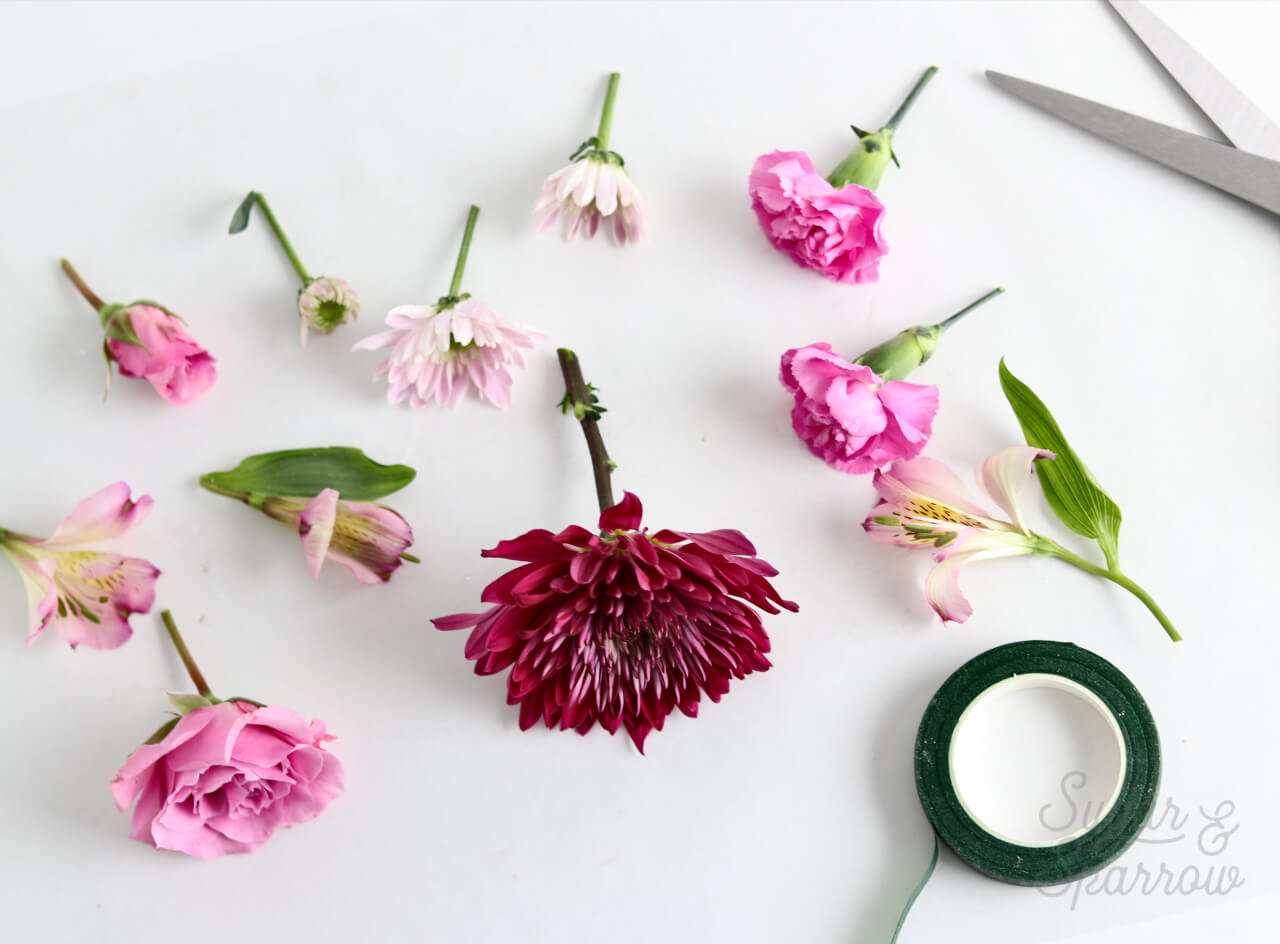
Pat the flowers and stems dry with a paper towel carefully.
Step 2: Wrap The Stems
Cut a piece of floral tape that’s about 2-3 inches long. Wrap the tape around the stem, focusing on covering the majority of the stem and where it’s been pruned. The goal here is to create a barrier between the cake and the stem, especially the bottom of the stem, and prevent it from leaking flower secretion (ok yes that’s gross sounding but also a good band name!) into the cake layer.

Wrapping the stem in this way also keeps the flowers fresh for longer, because it helps hold the moisture and nourishment within the stem.
Step 3: Decorate The Cake
Now that you’ve created a good barrier between the cake and your floral stems, plus you’ve set your mind at ease by choosing flowers from the safe list, it’s time to arrange them on your cake – my favorite part! I usually take some time to loosely plan where to place the flowers (off the cake) before committing to an arrangement. Once you’re happy with a plan, stick the covered stems into the cake one by one. Simple as that!
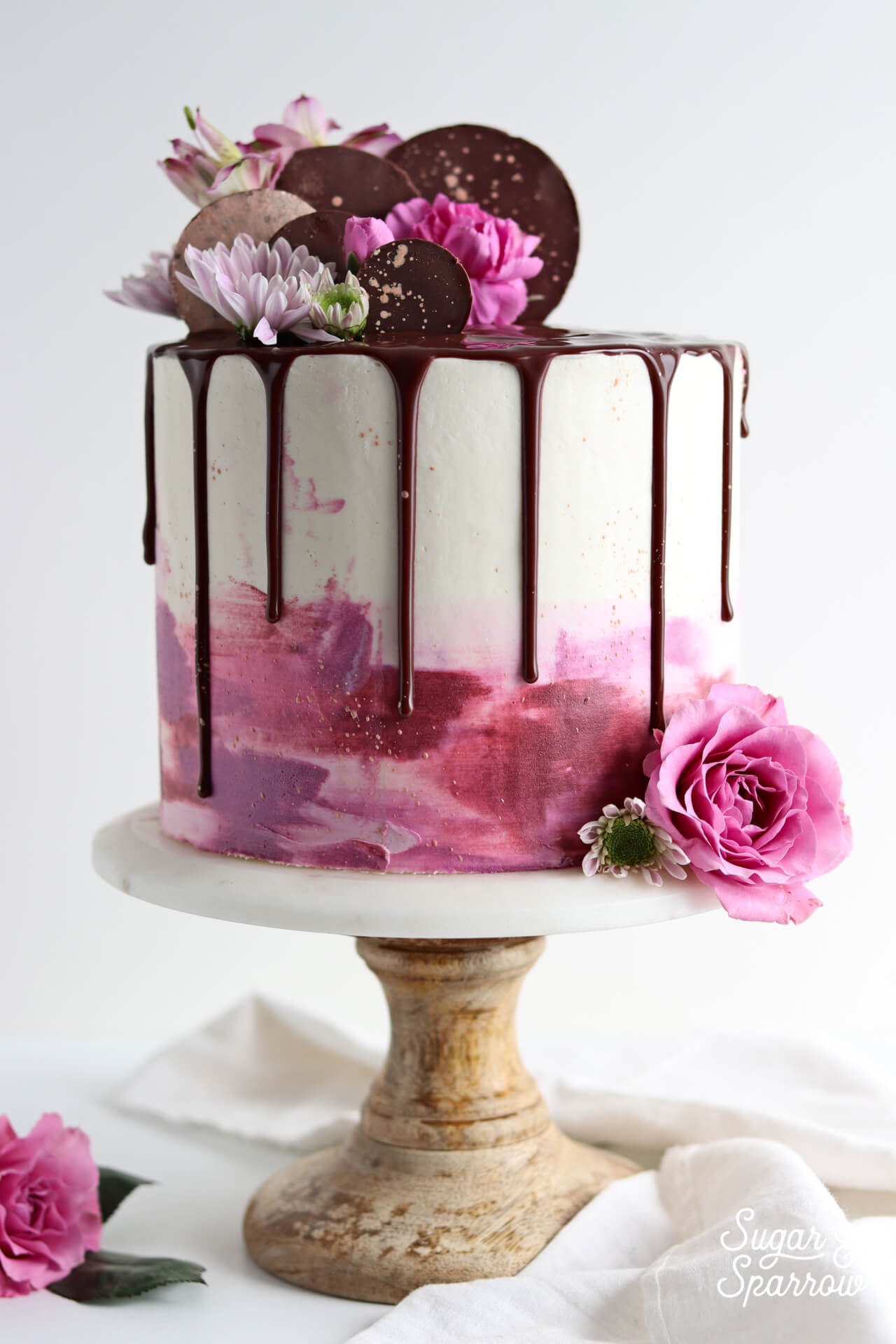
For larger flower bouquets, a great trick for keeping those stems from contaminating your cake is to create a small (1-2 inch) fondant ball and stick your stems into that before placing the whole thing on top of your cake. I’ve definitely used that trick for fuller floral arrangements and it works like a charm. You’ll still need to wrap your stems with floral tape before sticking them into the fondant holder to keep the moisture contained.
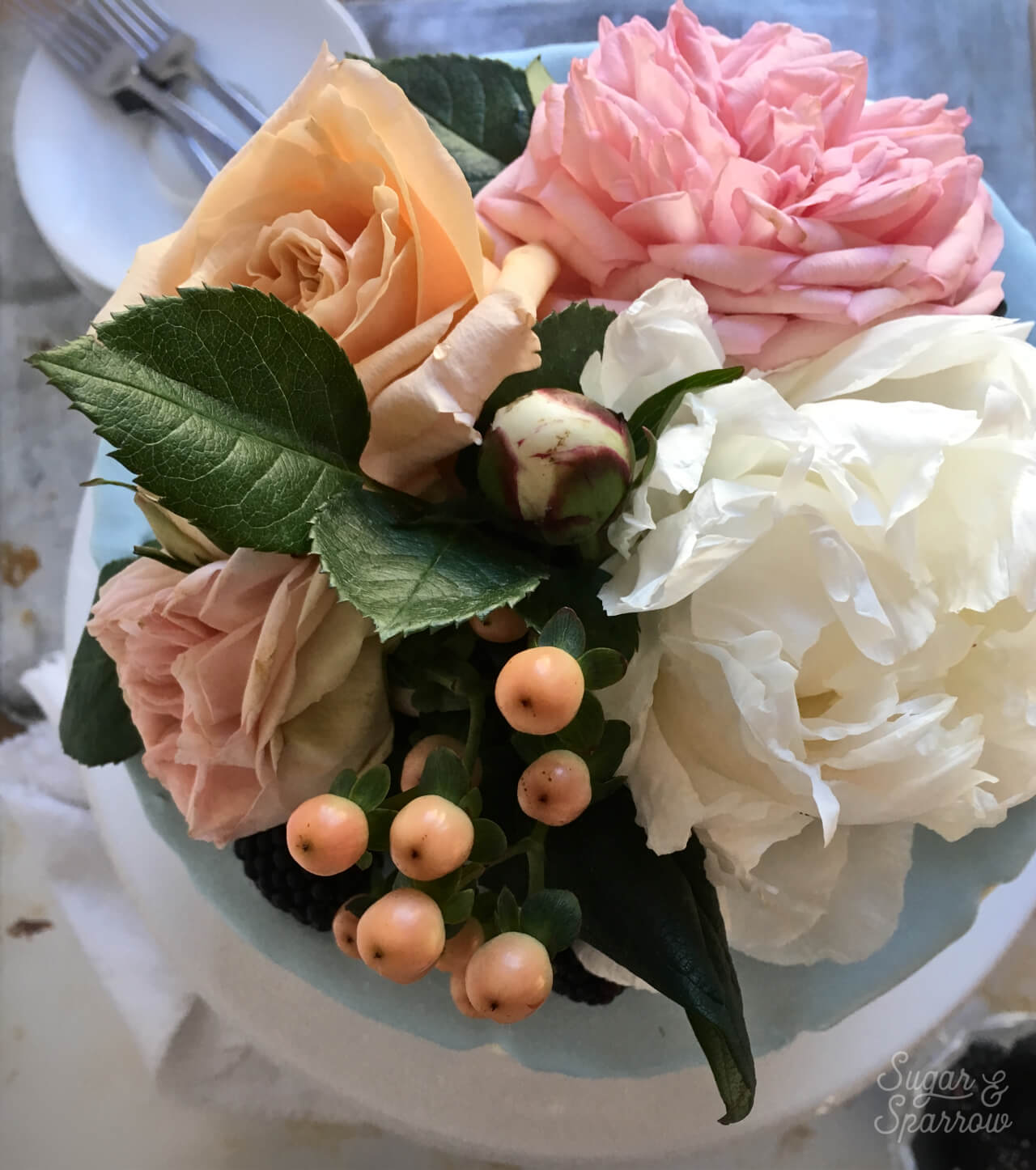
And if you’re really wanting to keep those flowers fresh, you can always try using one of those plastic tubes you get from the florist. You can fill them with a little water and stick your flowers into it like a vase before submerging it into the cake. I’ve never tried that method, but I hear it works great.
Storage And Timing
Keep in mind that each flower will have a specific lifespan once you wrap the stem, so the best way to be sure how long it will remain fresh is to ask your florist beforehand. In my experience, I’ve had really good luck storing cakes with fresh florals in the refrigerator. Typically, fresh flowers will last around eight hours in the refrigerator and remain fresh for a few hours outside of the fridge environment. Even though I’ve had good luck with the fridge, I always like to prepare and place the flowers at the very last second possible (sometimes even on-site at the event) to ensure the freshest blooms. Because after all that prep work and stressing over a cake, the last thing you want to happen is wilting.
Have you tried any of these methods before? Know any tips that aren’t on my list? I’d love to know your secrets for working with fresh florals too! Let me know in the comments.

Thanks for this very informative post. I do google flowers before purchasing them but sometimes flowers names are not included or easily recognizable. Do you just avoid those altogether? I do see a lot of cakes with peonies on them but when I googled them they came up as poisonous. I have a wedding cake coming up and the bride’s bouquet includes peonies and wanted to include them on the cake. Do you have a trusted source saying otherwise… and I hope you do because I want to use them! Also i was planning on using floral tape but recently came across a comment from someone saying they are not food safe. Thoughts on that? Thanks!
Hi Mais! I don’t have a go-to source for researching flowers (besides Google). I use floral tape all the time, but if you want to make things extra food safe you could insert the wrapped stems into a boba straw before placing it in the cake, or into a fondant ball placed on top of the cake so that no stems get inserted into the cake. If you’re concerned about the toxicity of a flower you could always use silk/fake flowers as well – I’m seeing that more and more!
How do I find pesticide-free flowers?
Hi Caroline! You’ll need to ask your local florists whether or not the flowers have been sprayed with pesticides.
Hi! I find that anytime I use this method, the floral tape gets soggy after a while and gets left behind in my cupcakes when pulling the flowers out. Any tips?
Hi Jenny! I’ve never tried this method with cupcakes but if I were to, I would try inserting the taped stems into a boba straw cut to fit the center of the cupcake. That way you can just pull out the whole straw and keep the cupcake fairly intact for consumption.
Hi Whitney! Loved how informative this blog is! It has helped me alot, honestly since I just started my small home bakery! I actually had a question regarding small flowers like baby’s breath. I’ve seen everyone put it on their cakes, and it looks gorgeous, but I just googled it and saw that those are poisonous! Do you know anything about it, and if there are any alternatives to those beautiful white small flowers? Thankyou in advance!!
Hi Ritika! I have not worked with baby’s breath before, but you’re right. After a quick Google search it seems that these flowers are toxic. Either the people using these on their cakes aren’t aware that they’re toxic or they are using artificial baby’s breath (which is what I would use if I were to make a cake with baby’s breath). Hope that helps!
Hey there! Have you ever worked with Iris and Tulips on a cake?
Hi Fran! I haven’t worked with either of those flowers on a cake. I would check with your local florist or do some Googling to see if those flowers are safe for cakes before decorating with them.
All this information is most helpful. I am also wondering about bleached dried florals? I am assuming they are toxic? Wondering if they are wrapped and put in a fondant “ball” if that would be safe? I am seeing this product used on cakes and wondering how to make sure it is food safe?
Thanks so much.
Hi Robyn! I’ve actually never heard of or worked with bleached dried florals so I don’t know what the process is for making them or what the level of toxicity is (if any). I would do a little research to see what info you can find before using them. My hunch is that if they’re commonly used on cakes nowadays, they’re either completely safe to use or there’s a method for making them safe (like putting the stems in a fondant ball, etc).
If I will freeze the flowers after making them safe for decorating in vacuum bag how many time it will hold on?
Hi Heela! It really depends on the type of flower because they have different wilting timeframes. You’ll need to research that specific type of flower to see how long it will last after cutting the stem. I’ve never frozen fresh flowers before, so I am not entirely sure how that will prolong the life of the flower.
Hi Whitney! This post has been so helpful!
Proteas?? And Silver Coin Gum Leaves??
If I wrap them and then insert a straw, I haven’t seen a lot online. Some sites say they’re toxic, some have no information? If they’re wrapped and in the straw, will they be okay?
Hi Madeline! I’ve never worked with Proteas or Silver Coin Gum Leaves before, and they weren’t on the “safe” list I compiled from the most common flowers used to top cakes. To be on the safe side, I would make sure they aren’t toxic before attempting to top a cake with them by researching online and possibly calling a florist. You might be able to get away with sticking the stems in a tube (so that no juices end up leaking through the wrapped stem and end of the straw into the cake) and placing some wax paper underneath where the petals would touch the cake, but you’ll want to know what the toxicity is before even attempting. Hope that helps a little!
I would love to know if peonues are ok to use on a cake
Hi Wendy! Do you mean Peonies? If so then yes, the petals are actually edible as long as they haven’t been sprayed with a pesticide. Simply follow the tutorial for preparing the flowers for your cake and you’ll be good to go!
Hi Whitney! Are chrysanthemums good to use? I know they are toxic for animals but would it be ok to add them to a cake?
Hi Cynthia! Although Chrysanthemums are not edible, they can be safely used on cake as long as you wrap the stems and prepare the flowers according to the tutorial.
Hi Whitney, this is an absolutely brilliant page with tips and tricks. So pleased to have a list of flowers to avoid as well. Thank you. xx
Yay, Janey! So happy to help!
Can you wrap flowers in tape the day before and keep in the frig?
Hi Debbie! It depends on the type of flower and what the wilting timeline is like. I’ve never pre-wrapped my flowers because I always want them to be their absolute freshest, so I stick to cutting/wrapping them the day of.
Hello,
Can we use Gerberas (fresh) on cake by wrapping their stams using cling wrap and toothpick?
Is it safe to use “Gerberas” ?
Hi Mihir! After a quick Google search it appears that Gerberas (Gerber Daisies) are safe to top cakes with considering you wrap the stems.
Hey Witney, I have bluejay blueberry flowers at home. Are they toxic? I didn’t see them on your list of toxic plants, but their not on your list of edible flowers either.
Hi Shannon! Are Bluejay Blueberry flowers the little white flowers that appear before they turn into blueberries? If so, from a quick Google search it appears they are edible and safe to use. My list only really covers the most common flowers that can be used for cakes or should be avoided. If the flower you’re referring to is something different than what my Google results were, be sure to do some more in depth research before adding them to your cake.
Thank you so much for your wonderful post. Very helpful indeed!! I have tape, scissors, etc…I’m at the ready! Wondering….have you seen this from Chelsweets? I thought it was clever. For the top of a cake, she takes a cake board, the same size as the cake below it, and covers it in buttercream. Uses a lot of buttercream, but she creates mounds of it and pops the cut flowers directly into the buttercream. The board can then be removed from the cake below, flowers and all, never touching the cake!! Neat!! I find you very inspirational. Thanks so much!!
Hi Paula! I haven’t seen that technique before but it’s genius!! Gonna have to give that a try next time I work with fresh flowers.