
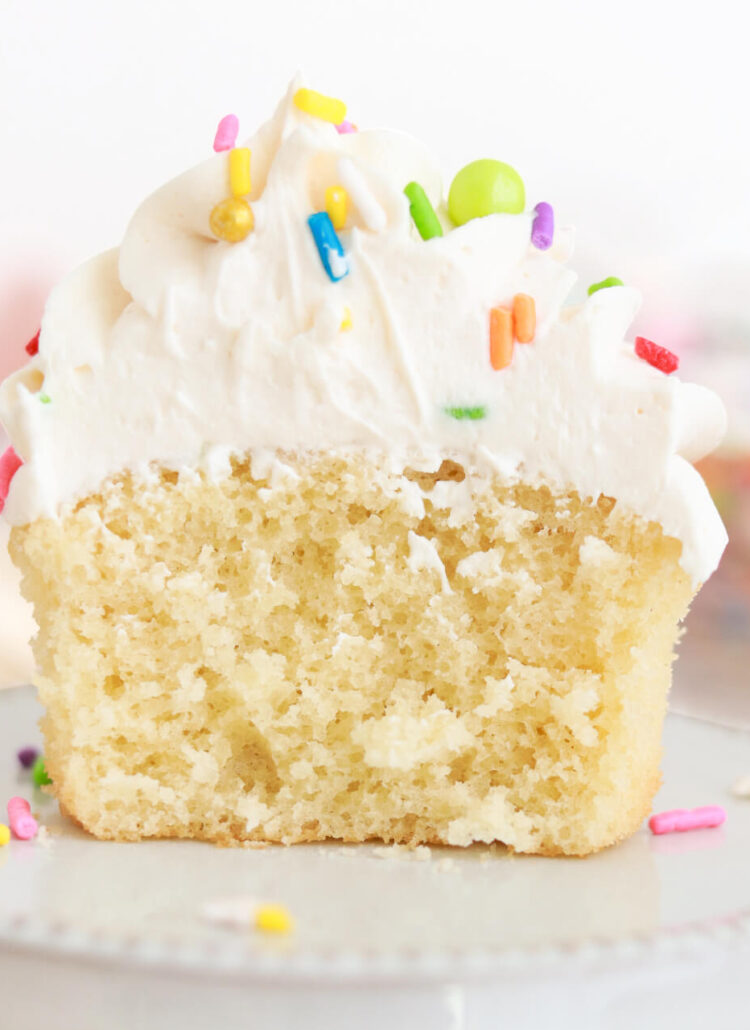
This is my favorite from-scratch vanilla cake recipe that was created after TONS of recipe testing in search of the perfect vanilla cake – one that has the light and fluffy texture of box cake mix, is packed with vanilla flavor, and super easy to make. This one checks all of those boxes and has become a go-to for me and for many of you, which makes me so happy! Pair it with vanilla buttercream and pretty sprinkles for the ultimate vanilla birthday cake, or pair it with any of my other frostings to mix it up. It goes well with everything!

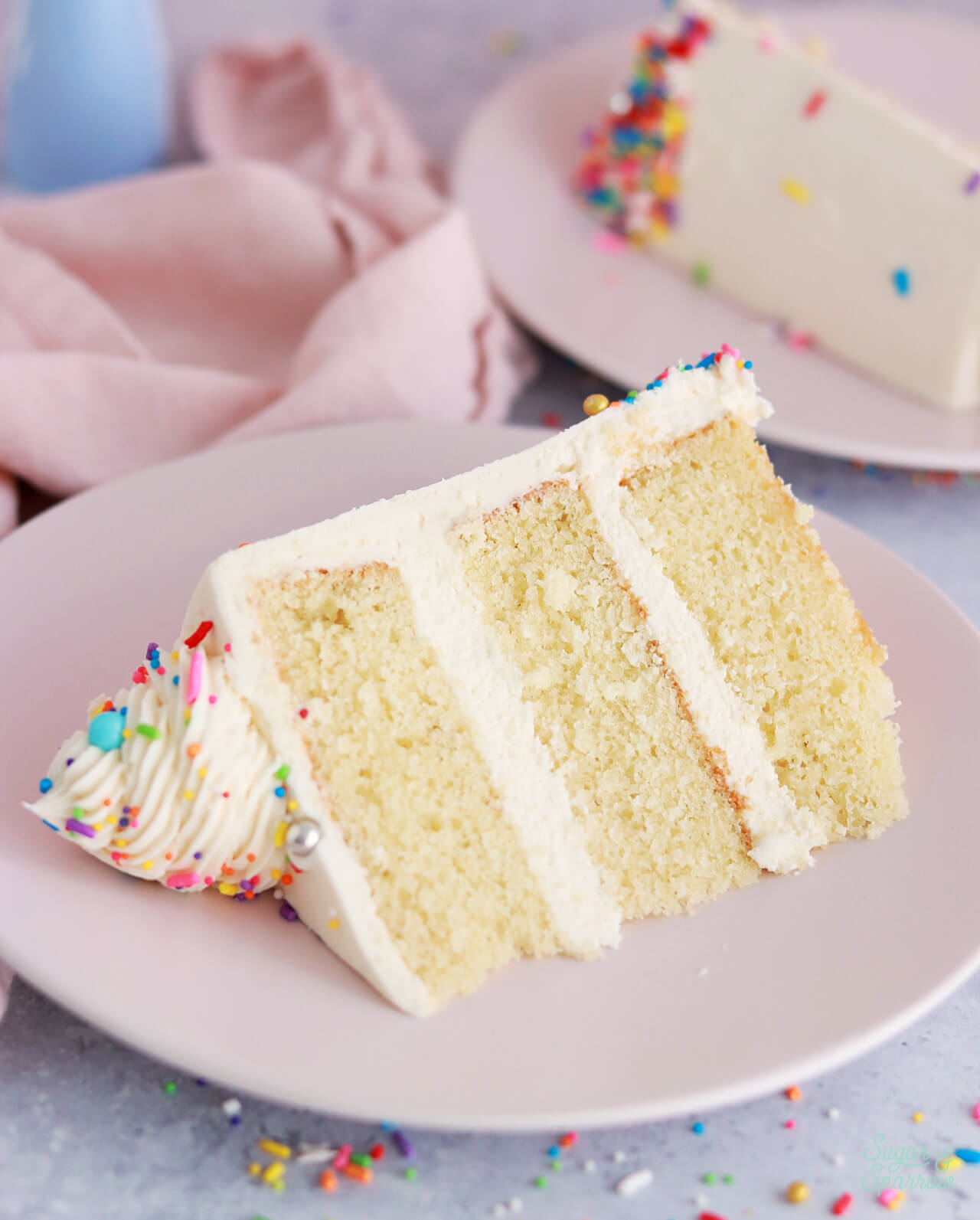
One reader, Haley, says: “1000% this is the best vanilla cake recipe I have ever made. I quite literally NEVER leave reviews on things that I try, but there is no way that I could go without telling you how DELICIOUS this cake is.” ★★★★★
From-Scratch Vanilla Cake that Rivals Box Mix
I have a little confession to make: when I first started making cakes, my secret go-to for far too long was the box vanilla cake mix by Betty Crocker.
Phew. Now you know.
Since I became accustomed to the light and fluffy texture of said box mix, every time I tried to make a vanilla cake from scratch, the result seemed off. Blame it on the lack of Propylene Glycol Mono (or the handful of other ingredients in box mixes that you’ve never heard of), but my from-scratch vanilla cakes always ended up too dense, tasted a little cornbread-ish, and just didn’t have that fluffy appeal. Finding a go-to vanilla cake recipe from scratch felt like a mountain I had to climb, but after (what felt like) five hundred tries and a whole lot of not giving up, I’ve found a recipe that is beyond my wildest cake dreams.
Perfect Vanilla Cake Ingredients & Substitutions
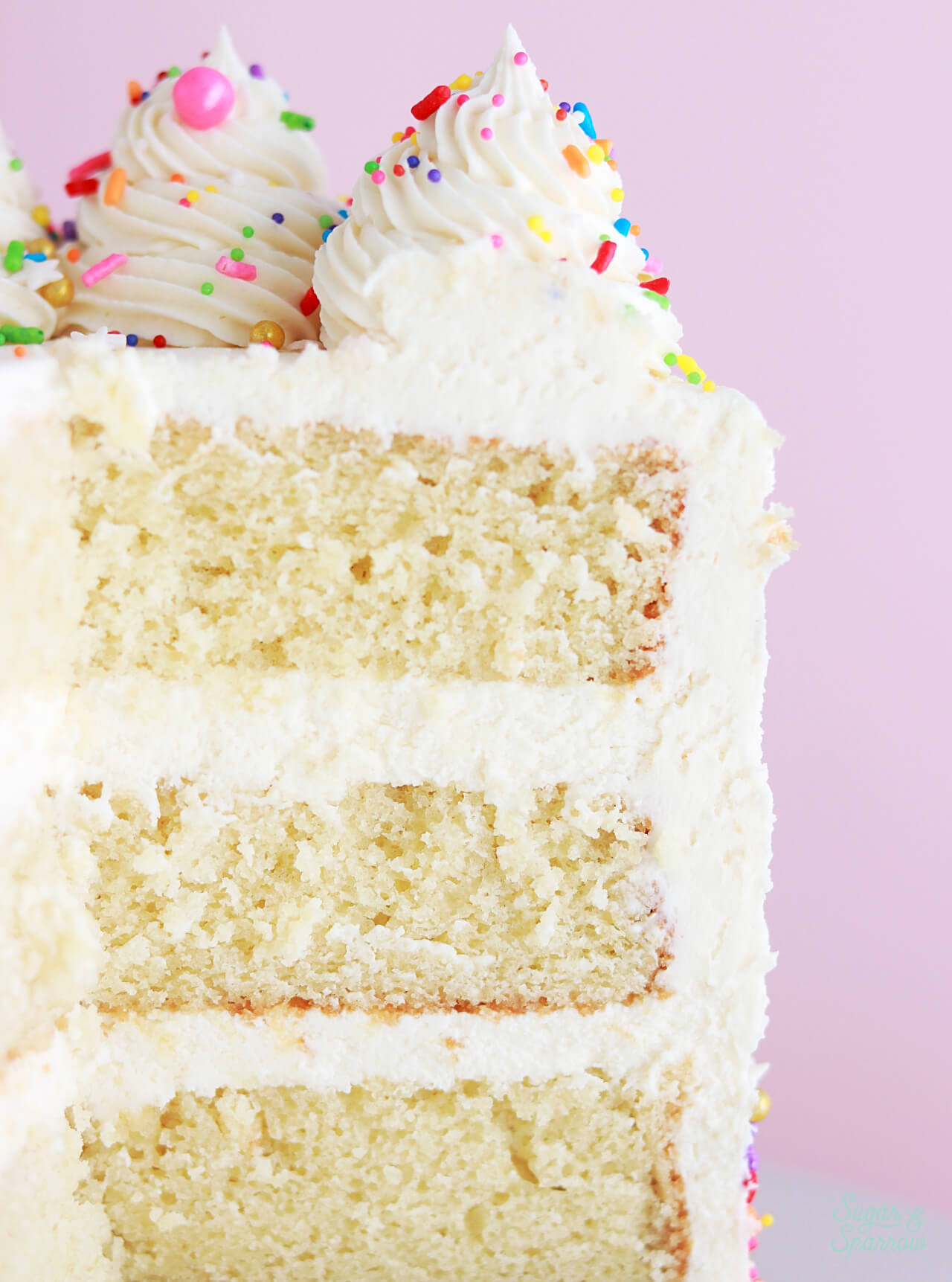
This vanilla cake is soft and moist, so easy to whip up, and tastes like a dream. There are some key ingredients that make it this way, and I’ve listed them below. I’ve also shared some substitutions that can be made just in case you’re in a pinch:
- Cake Flour. To achieve the super soft texture in this cake, I swear by cake flour. It produces a much fluffier cake than all-purpose (or plain) flour because of its lower protein content (the more protein in your flour the stiffer the dough and less ability to maintain moisture). You can find cake flour at most grocery stores, but if all you’ve got is all-purpose flour in your pantry, here are instructions for how to make your own cake flour. Keep in mind that if you do use the homemade version, the gram measurement will weigh more (325g instead of 290g) since all-purpose flour is heavier than cake flour.
- Baking Powder + Baking Soda. The leavening agents in this recipe. Using both makes it the perfect amount of fluffy.
- Unsalted Butter. The main fat in this recipe, which adds lots of moisture, great structure, and rich flavor. If you only have salted butter on hand, you can substitute that but be sure to omit the salt in the recipe if you do.
- Granulated Sugar. This not only sweetens the cake, it creates a tender crumb as well. You can substitute this with caster sugar if you wish and it will be even more soft.
- Whole Eggs + Egg Whites. I use two large eggs and two large egg whites in this recipe. The egg whites keep the cake lighter while adding the perfect amount of protein and binding power.
- Sour Cream. Sour cream adds the perfect amount of moisture to this cake. If you don’t have that locally you can substitute it for plain yogurt or Crème fraîche.
- Pure Vanilla Extract. I use an entire tablespoon of vanilla extract in this cake, which takes the flavor beyond! I recommend using a quality vanilla extract here (not imitation). You can substitute the extract for vanilla bean paste if you wish.
- Whole Milk. Since it has the highest fat percentage of any milk (aside from buttermilk), the whole milk creates a rich crumb while binding the ingredients together. You can technically substitute this for another kind of milk, but whole milk is going to yield the best results.
Vanilla Cake Baking Tips for Success
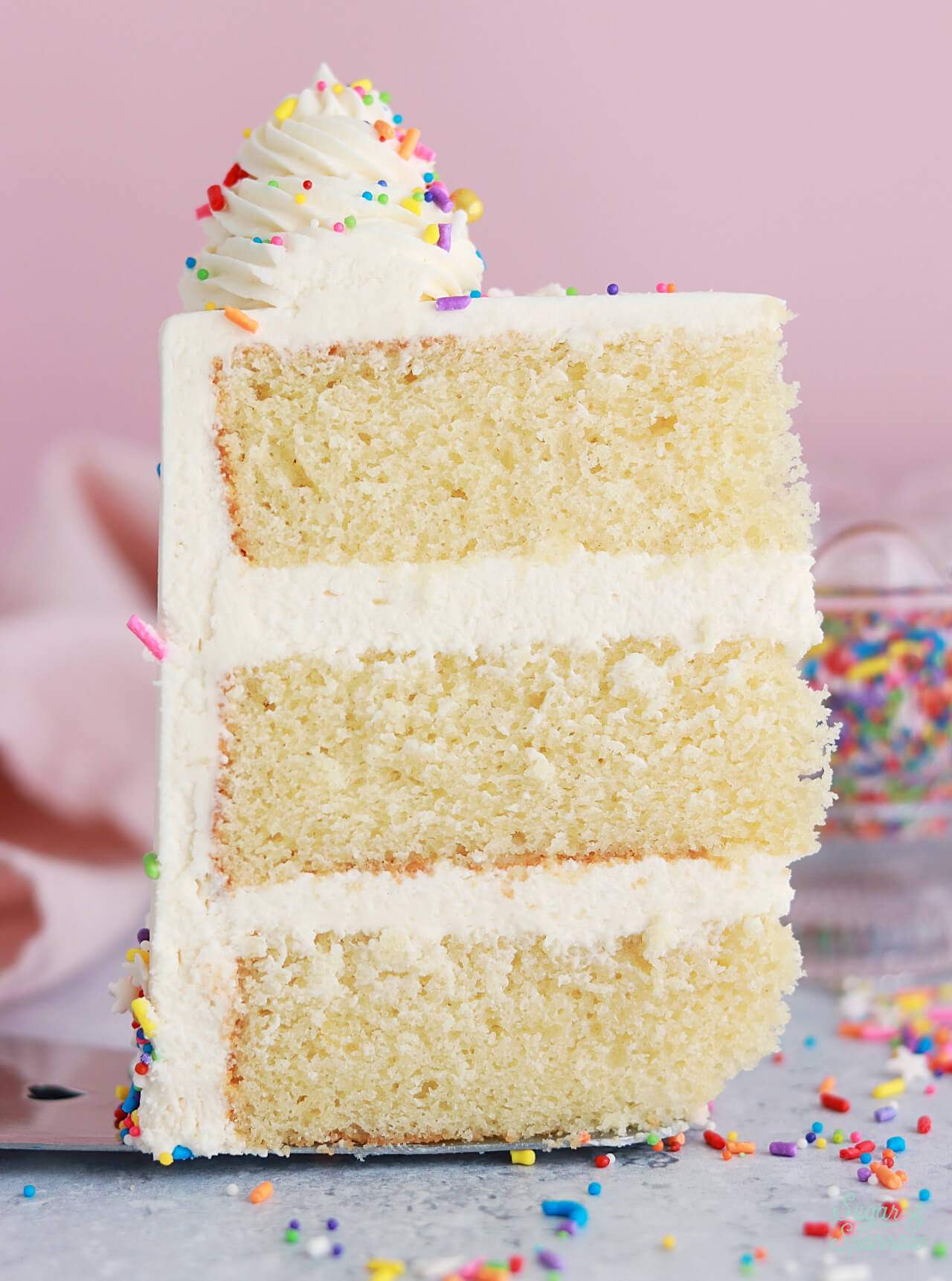
Even if you have all the right ingredients, it’s important to follow a few ground rules when it comes to baking this cake (or really any cake). Here are a few best practices that will really set you up for success:
- Start with room temperature ingredients. Cake baking is a science, and when ingredients like eggs, butter, and dairy are at room temperature, they form an emulsion which traps air in the batter. Once you place that batter in the oven, the trapped air expands and gives your cake a good rise and lovely, tender crumb. It’ll only happen when you use room temperature ingredients, so if you want your cake to live up to it’s true potential, don’t skip this step.
- Use fresh baking powder and baking soda. Each of these leavening agents are responsible for helping your cake to rise. Once their containers are open, they only have a six month shelf life! When they’re past their expiration date, the chemical reaction that causes your cake to rise won’t happen. If you want those cakes to rise beautifully, make sure your baking powder and baking soda are within that 6 month window.
- Use the paddle attachment on your stand mixer. Also known as the “flat beater” attachment, the paddle attachment helps incorporate just the right amount of air. Other attachments might add too much air to your cake batter, causing them to become over-mixed and potentially sink in the baking process. If you don’t have a stand mixer, an electric hand mixer works just fine.
- Be careful not to over or under mix. Under-mixing the batter will prevent important chemical reactions from happening in your cake batter, and over-mixing will lead to too much gluten development (aka a dense cake). In order to help you mix for the right amount of time, I’ve listed all of the mixing times in the recipe below. Follow those exactly for best results!
- Know your oven. I’ve written this recipe (and all of my recipes) for a conventional oven. If you have a convection or fan-assisted oven, you’ll want to reduce the baking temperature to 325ºF (163ºC) and check for doneness a few minutes earlier than specified.
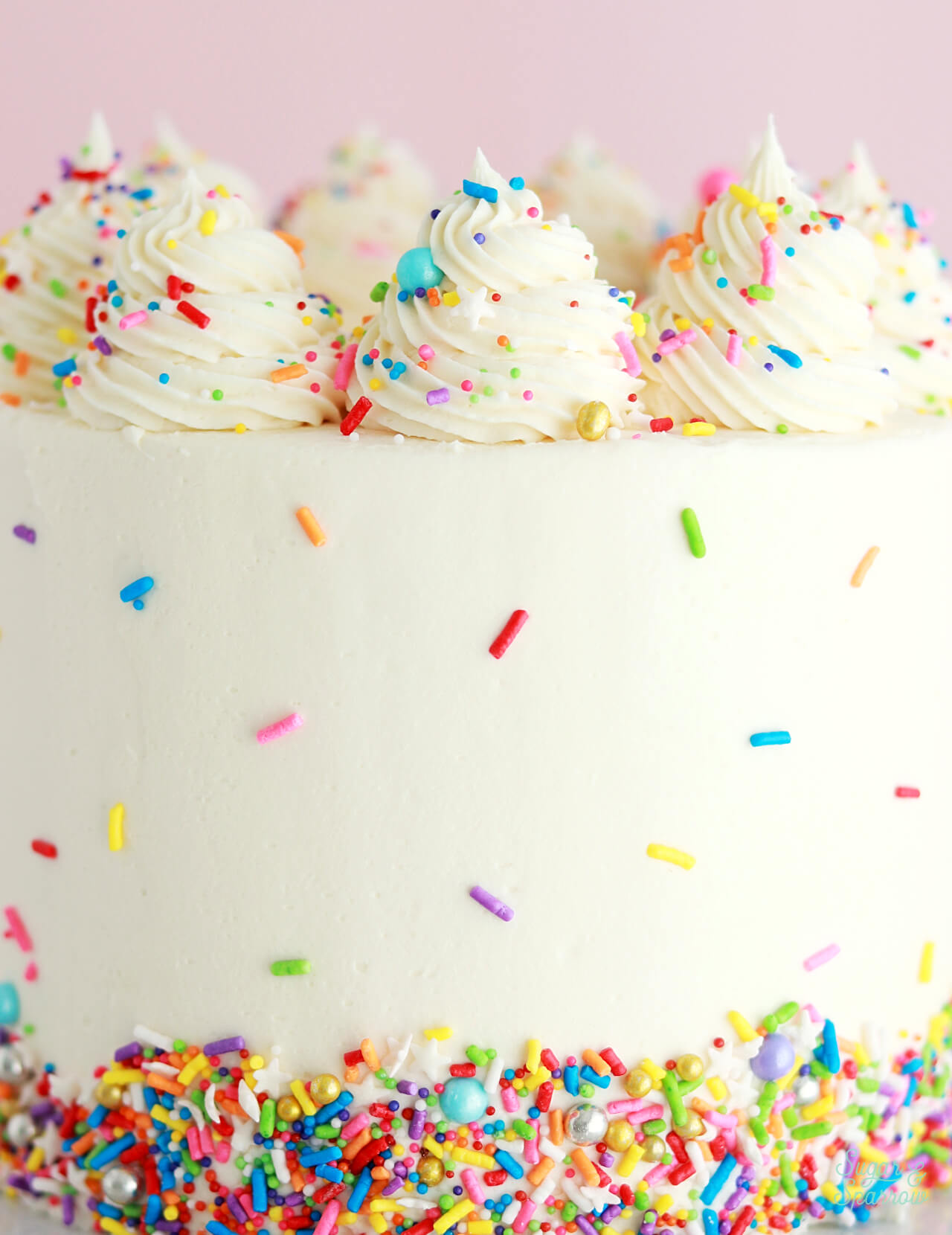
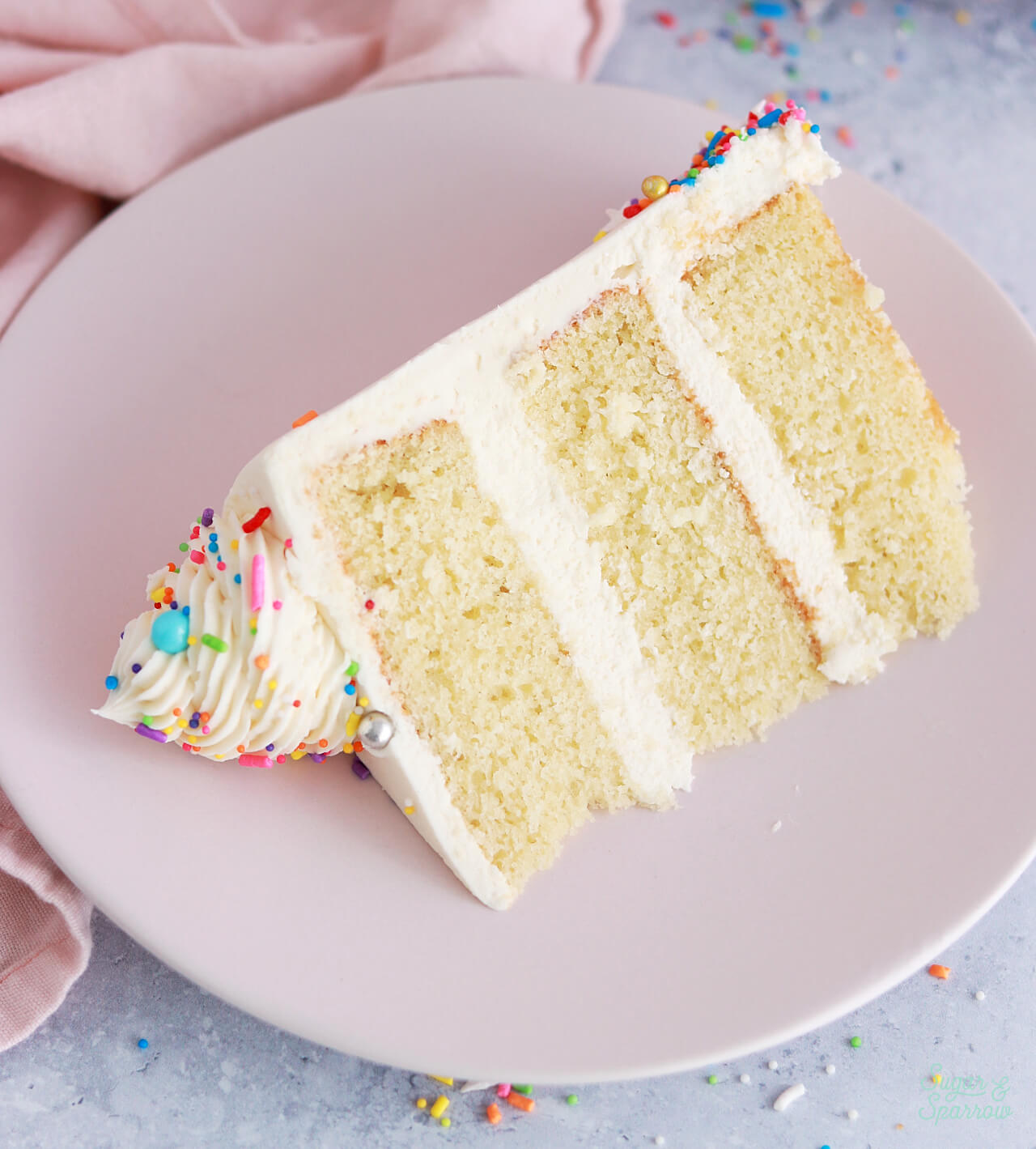
Here’s a quick video to show you the process for making this vanilla cake:
If you love recipe videos like this one, be sure to check out my YouTube channel! I’ve got a growing collection of cake recipes, decorating tutorials, and Cake Basics over there. Hit the subscribe button on my page so you never miss a new video.
What Frosting to Pair with Vanilla Cake
This vanilla cake pairs well with so many buttercream flavors, but if you want to keep things on the vanilla spectrum, try pairing it with a double batch of my Vanilla Buttercream Recipe. It does not disappoint!
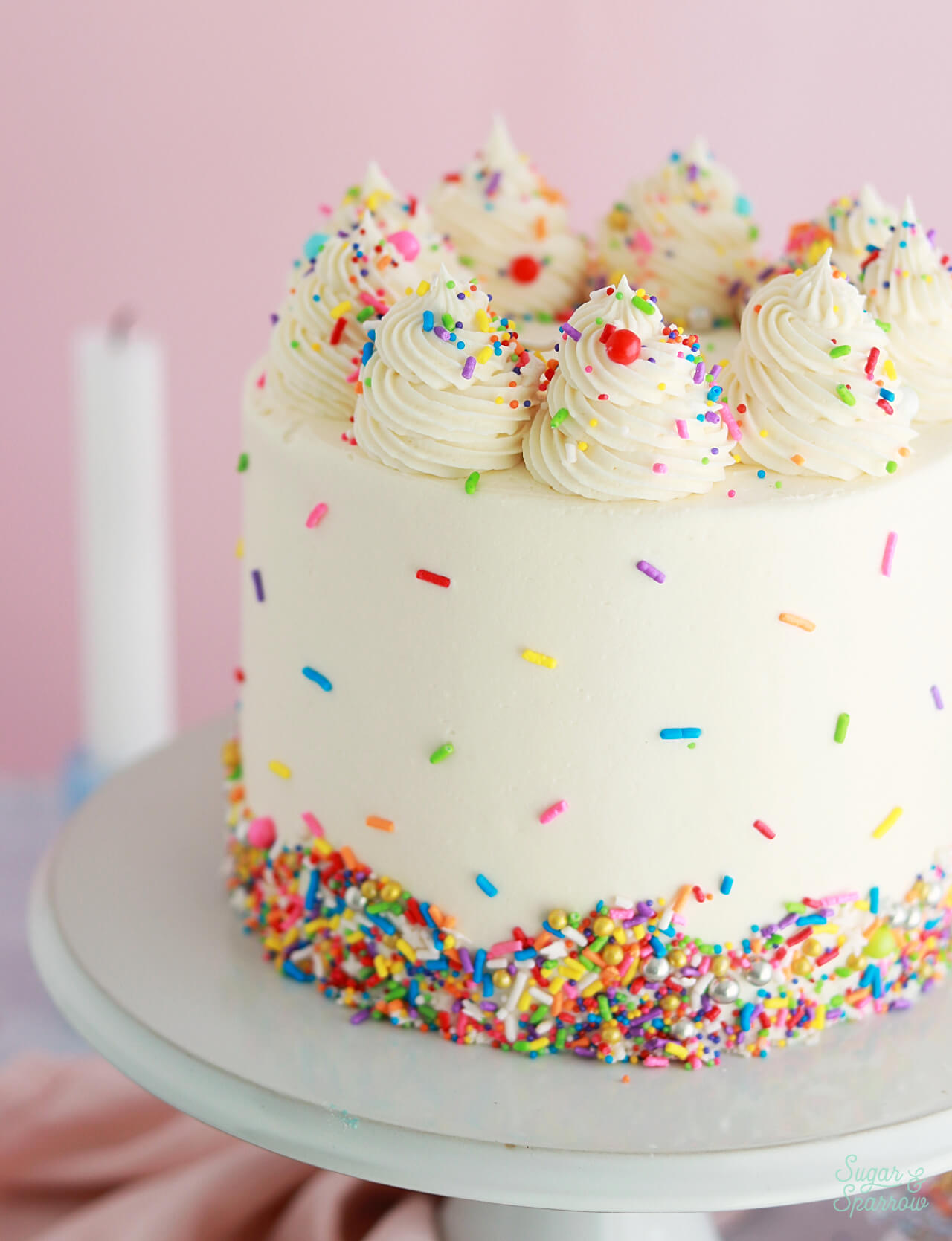
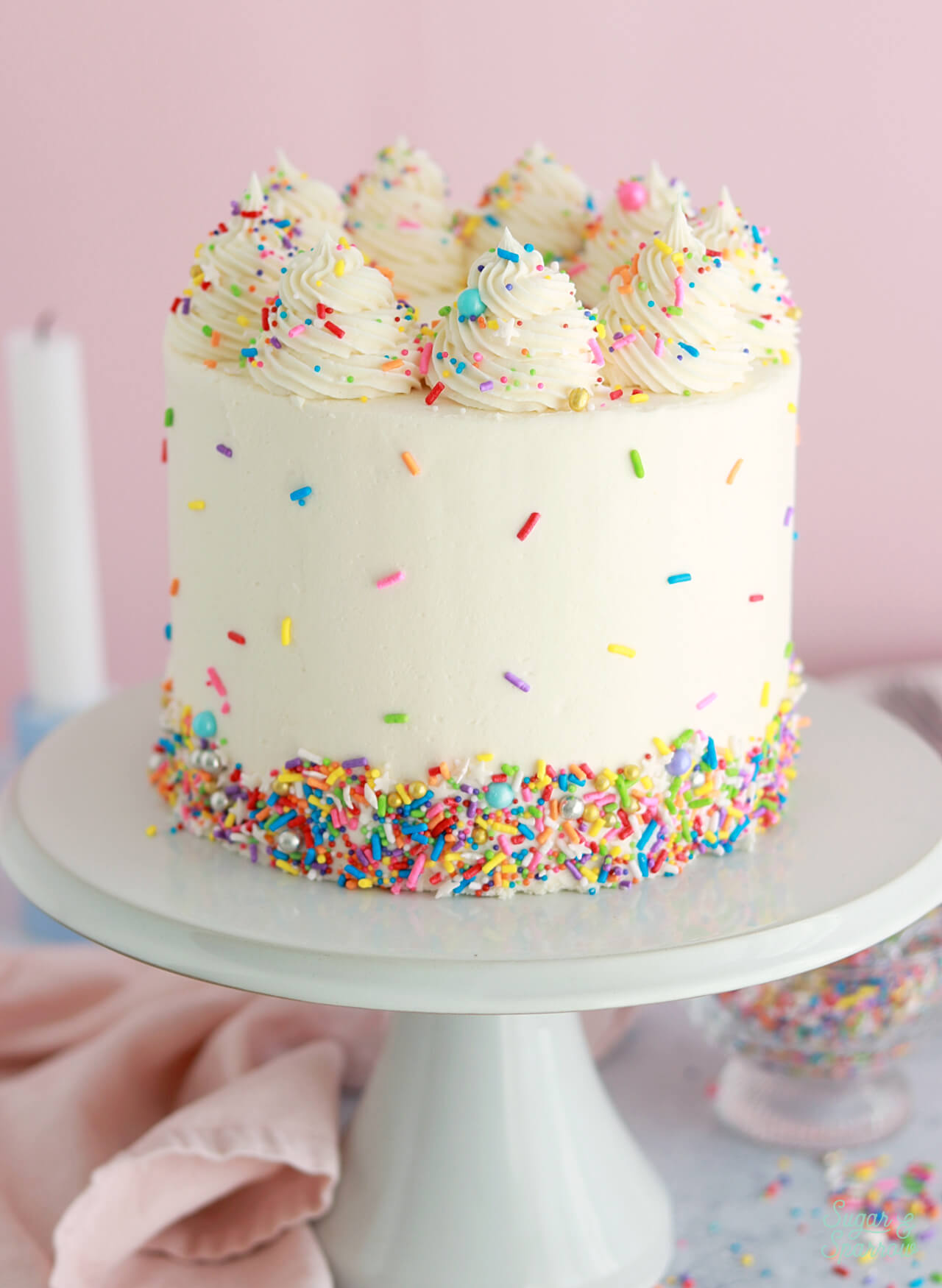
If you’d rather switch things up, a double batch of any of my frosting recipes will work great! I’ve got recipes for alternative cake fillings here as well.
Updates
In 2022: I slightly changed the measurements of these same ingredients to make this cake even more soft and light! The original recipe is in this youtube video if you’ve come to love that one.
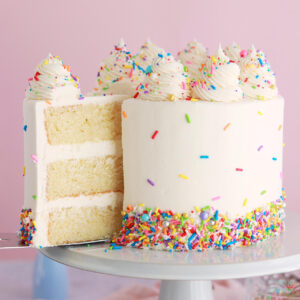
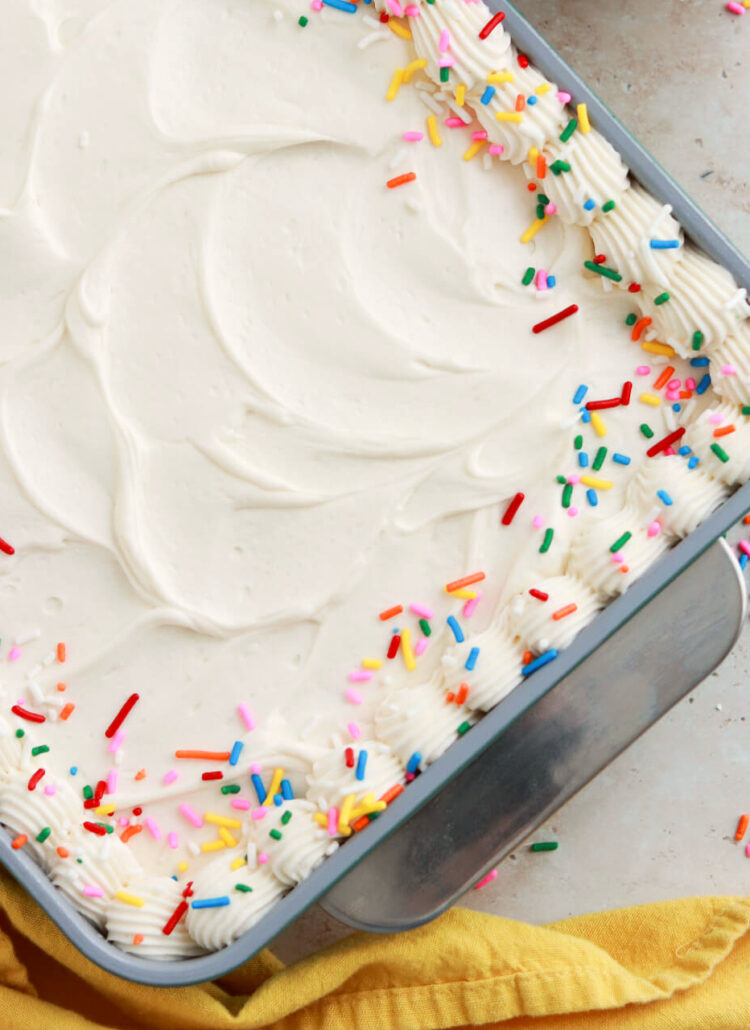
In 2025: I finally updated the photos to show more of the inside of the cake! The exterior decoration changed to reflect a simpler design as well. Basically a smooth buttercream finish, these pretty rainbow sprinkles, and swirls on top created with Wilton Tip 4B.
Perfect Vanilla Cake Recipe
Ingredients
Vanilla Cake
- 2 3/4 Cups (290g) sifted cake flour* DIY recipe in notes
- 2 tsp baking powder
- 1/2 tsp baking soda
- 1 tsp salt
- 3/4 Cup (170g) unsalted butter, room temperature
- 1 1/2 Cups (300g) granulated white sugar
- 2 large eggs + 2 egg whites, room temperature
- 1/2 cup (120g) sour cream, room temperature
- 1 Tbsp pure vanilla extract
- 1 Cup (240ml) whole milk, room temperature
Vanilla Frosting
- 2 batches vanilla buttercream
Instructions
- Preheat the oven to 350°F. Prepare three 6-inch cake pans or two 8-inch or 9-inch cake pans by spraying the sides with a cooking spray (Baker's Joy is my favorite) and fitting a parchment paper circle to the bottom of the pan.
- Sift the cake flour and then measure by spooning and leveling it in your measuring cup. Add the cake flour, baking powder, baking soda, and salt into a bowl and whisk to combine. Set aside.
- In the bowl of your stand mixer (a handheld mixer works fine too!), beat the butter on high for two minutes until it's light and creamy. Add in the sugar and continue to mix on medium-high for another two minutes. Turn the mixer to low and add the eggs and egg whites, one at a time, mixing until just combined and scraping down the bowl and paddle as needed. Add the vanilla and sour cream, turn the mixer to high, and beat for one full minute. It will look curdled at this point, but don’t worry – it will become smooth cake batter at the end.
- Add in the dry ingredients all at once and turn the mixer to low speed. Mix until just combined, then slowly pour in the milk. Continue to mix on low speed until just combined, about 30 seconds. Scrape down the sides and bottom of the bowl and give it a few stirs with a whisk to make sure there are no lumps. The batter will be slightly thick.
- Pour the batter evenly into the prepared cake pans and bake for 30-35 minutes. They're done when they spring back to the touch and a toothpick inserted into the middle comes out clean. Let the cakes cool in the pan for five minutes before turning them out onto a wire rack for an additional few hours of cooling. Make sure they're entirely room temperature before filling and frosting with a double batch of my vanilla buttercream (or any frosting!).

Lovely cake—it was a hit with 30 party goers. I do have a question. My cake turned out a bit dense, very delicious but not light and fluffy. I followed the recipe to a “t”…do you think the wrapping/refrigeration of it made it “dense up”? What would attribute to the density?
So happy the recipe was a hit, Susan! The cake being dense could definitely be from wrapping the cake layers and storing them in the refrigerator (if that’s how you stored them before decorating). I always store mine at room temperature and wrap them only after they’re totally cooled. A dense cake could be the result of overmixing as well, but if you followed the recipe exactly it sounds like you shouldn’t have a problem there.
Hmmmm….I did store them wrapped and in the fridge before decorating. And maybe, just maybe I over mixed it…will try again (b/c really, it was still a huge winner…just trying to perfect my cake game!) THANKS for your help!
Of course, Susan! Definitely give it another go and I have a video with tips on how to make this vanilla cake recipe here: https://www.youtube.com/watch?v=XLMUYwvOnys
Do you think this cake with stand up ok to a marscapone strawberry filling? I’m worried that if it is too delicate it may not hold up to the potential moisture of the strawberry filling….
Hi Susan! I have never tried marscapone filling before but I have a friend who uses it with my vanilla cake recipe all the time! If you’re worried about the filling being too liquid you can always pipe a stiffer buttercream dam around the edge of the cake to ensure that the layer above won’t squish the filling out.
Whitney, congratulations on perfecting this recipe! I have to ask, have you ever made this I more than a 2x batch? I have been pulling my hair out (and there’s not much to begin with!) trying to make a successful vanilla cake that doesn’t fail when scaled up despite trying to avoid overmixing. Even reverse creaming let’s me down! Anyway, thank you for your time, dedication, and generosity in sharing all your hard work!
Hi Tanya! I have never made more than double this recipe in one mixer (if I need a triple batch I use an additional mixer). Doubling it works great in my experience though!
I’ve been set the task by my daughter to make one of your cakes for her birthday this weekend! 🙂 I wanted to check it’s definitely granulated sugar (does it not make it grainy?), as I’d usually use caster sugar in my cakes. Thanks. 🙂 x
Hi Rachael! So excited for you to make this cake! I always use granulated white sugar in my cakes and they’ve never tasted grainy after baking (the heat from the oven melts it evenly as the cake bakes). I’ve never tried using caster sugar, but from what I’ve read it’s the same white sugar, only ground a little more fine, and you can substitute it in recipes that call for granulated. I hope this recipe is a hit for your daughter’s birthday!
Hello! I have followed your blog and have made quite a few cakes following your recipes. They have all turned out to be delicious! But every time I make the vanilla cake the tops are a little sticky. Is that normal? If not what can I do to fix it. I have followed the recipe as is and no substitutions.
Hi Divya! So happy you’ve been loving my recipes. A sticky cake top is typically caused by wrapping the cake for storage before it’s completely cooled. The fix is simple – let the cakes cool completely without wrapping them and use them right away once they’re room temperature. Or you can do what I do: cut off the cake tops with a cake level before filling and stacking them.
Hi! Will this recipe work with the Cup 4 cup flour for a gluten free cake? Thank you!
Hi Irene! I’m not entirely sure since I’ve never tried gluten free baking. I would research the kind of flour you’re wanting to use to see if it’s a cup for cup substitution. It should say on the package of GF flour, so I would just go with what the brand recommends.
Hi I followed your recipe but my cake batter curdled and when baked the cake was very greasy. What am I doing wrong?
Hi Lisa! That’s interesting, I’ve never had or heard of issues with this cake batter curdling. Did you substitute any ingredients?
I’ve just found this recipe- and have used it twice already for birthdays! It is delicious!
Thank you so much for all the tips and tricks- you make understanding the recipe very easy!
Hi Jennifer! That is so wonderful to hear! I’m glad the recipe is a hit and you’ve found a good go-to 🙂
hi! Do you know how tall 3 layers of the 6″ round cake ends up being? Need to bake for a friend and would love to know so I can get an appropriate cake box would be a travesty to make such a pretty cake and not be able to transport!
Hi Tess! Depending on how much filling and how you torte the layers, a 3 layer 6″ cake ends up being 5-6 inches tall.
Hi Whitney 🙂 I am going to use this recipe tonight and cant wait! I only have 7″ tins and I would like to for 5/6 layers? should I double the recipe? Also – I have a fan assisted oven, would you lower the temp in degrees Celsius?
thank you so much 🙂
Hi Emily! For 5-6 layers in a 7 inch cake pan I would double the recipe. You’ll have just enough for that amount! And as far as a fan assisted oven, I’ve never used one but I read online that the oven temp should be adjusted downward by 20ºC. Hope that helps!
Hi, I just randomly found this recipe on Instagram and am so excited to try it out. I was wonder, since the recipe uses cake flour, does that mean the sponge will be a little softer than other normal sponge cakes? Will it be stable enough to stake and add fondant figurines on top of the cake? Thanks!
Hi Kim! Happy you found this recipe – it’s one of my all time faves! The sponge of this cake is soft and fluffy, but it’s definitely stable enough to stack and add fondant figures to the top. I’ve done that many times before 🙂 Enjoy!
I made birthday cake following all the parts of the recipe including vanilla Butter cream frostin. It was great,just felt little too sweet.to adjust that what should i do?
Hi Atiya! Glad you loved the recipe! If you want to reduce the sweetness in the cake, you can reduce the amount of white granulated sugar to 1 1/2 Cups. If you want to reduce the amount of sweetness in the frosting, you can either use salted butter instead of unsalted, or add a little more salt at the end. You can also try reducing the amount of powdered sugar by 1/2 Cup but it will be less thick.
Hi, This was my first time making a cake and I ended up using this recipe. The cake turned out amazing!
I can’t wait to try it again
The steps were very easy to follow
And I will definitely try some of your other cakes
Thanks so much
Oh and I forgot to rate it 5 stars 🙂
So happy you loved the recipe, Zoe! Thanks for letting me know and I can’t wait for you to try some more cake recipes!
Hi Whitney! Could you tell me if this recipe would this recipe work in a 9×13 pan?
Hi Mel! I’ve actually never tried this as a 9 x 13 sheet cake, so I’m not sure how it will turn out but my hunch is that it will work. Just make sure to fill the pan no more than 1/2 full, bake at 350, and check it at 35 minutes to see if it needs longer. Let me know how it turns out!
Hi Whitney,
I was just wondering how to ensure the sides of the cakes don’t get too dark? I’ve noticed from following a lot of Instagram bakers that the sides of their vanilla cakes are not much darker than the rest of the cake. I made your funfetti cake for my daughters birthday which was delicious but the sides of the cake were quite dark and a bit over cooked even though I only kept them in the oven long enough to be cooked properly in the middle.
Thanks heaps
Hi Renee! The only reason that the sides might get darker is if your oven temp is actually hotter than what the display reads. This cake (which is the same recipe as the funfetti cake minus the sprinkles) should only get golden brown on the edges and top when it’s done cooking. You can buy an oven thermometer to read the actual temp and adjust accordingly.
Hi Whitney. Just wondering if it’s ok to use self raising flour instead of plain with soda, powder and salt? Thank you. :0)
Hi Lovanah! I don’t use self-rising flour because it doesn’t have the low protein content of cake flour and has additives like baking powder (hence the term self rising). If you substitute self-rising flour, it would add too much leavening agent to this recipe which would actually make it sink in the middle once you bake it. Instead, I recommend store bought cake flour, or if you don’t have that on hand, you can convert all-purpose flour into cake flour using this recipe: https://sugarandsparrow.com/homemade-cake-flour-recipe/