
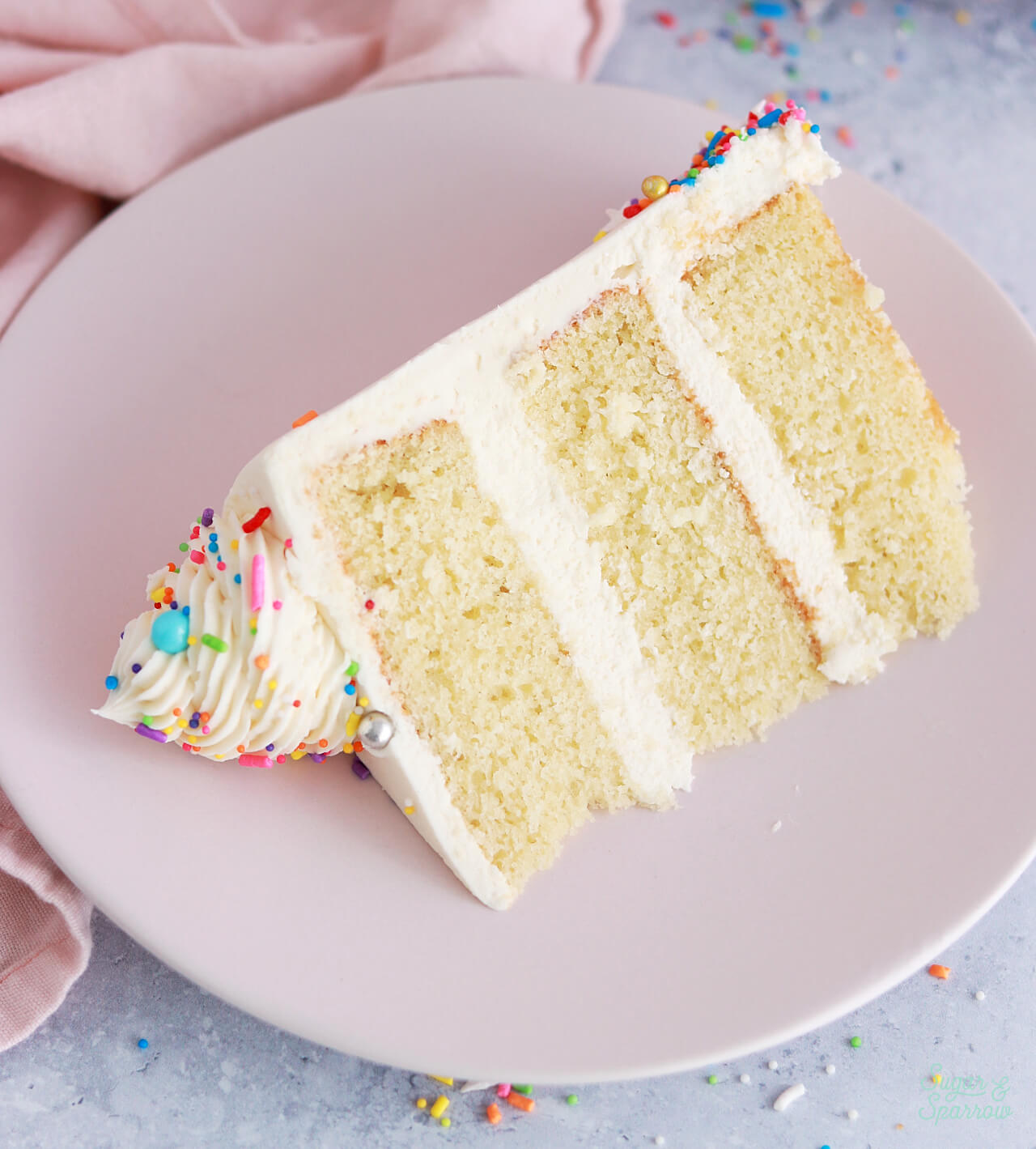
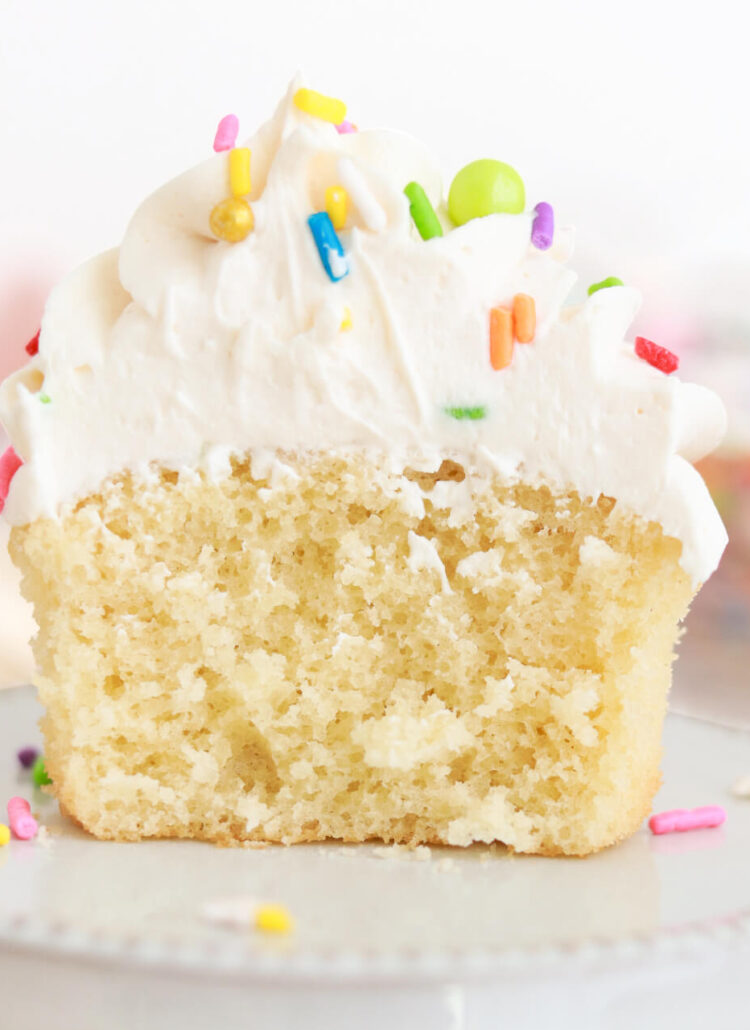
This is my favorite from-scratch vanilla cake recipe that was created after TONS of recipe testing in search of the perfect vanilla cake – one that has the light and fluffy texture of box cake mix, is packed with vanilla flavor, and super easy to make. This one checks all of those boxes and has become a go-to for me and for many of you, which makes me so happy! Pair it with vanilla buttercream and pretty sprinkles for the ultimate vanilla birthday cake, or pair it with any of my other frostings to mix it up. It goes well with everything!

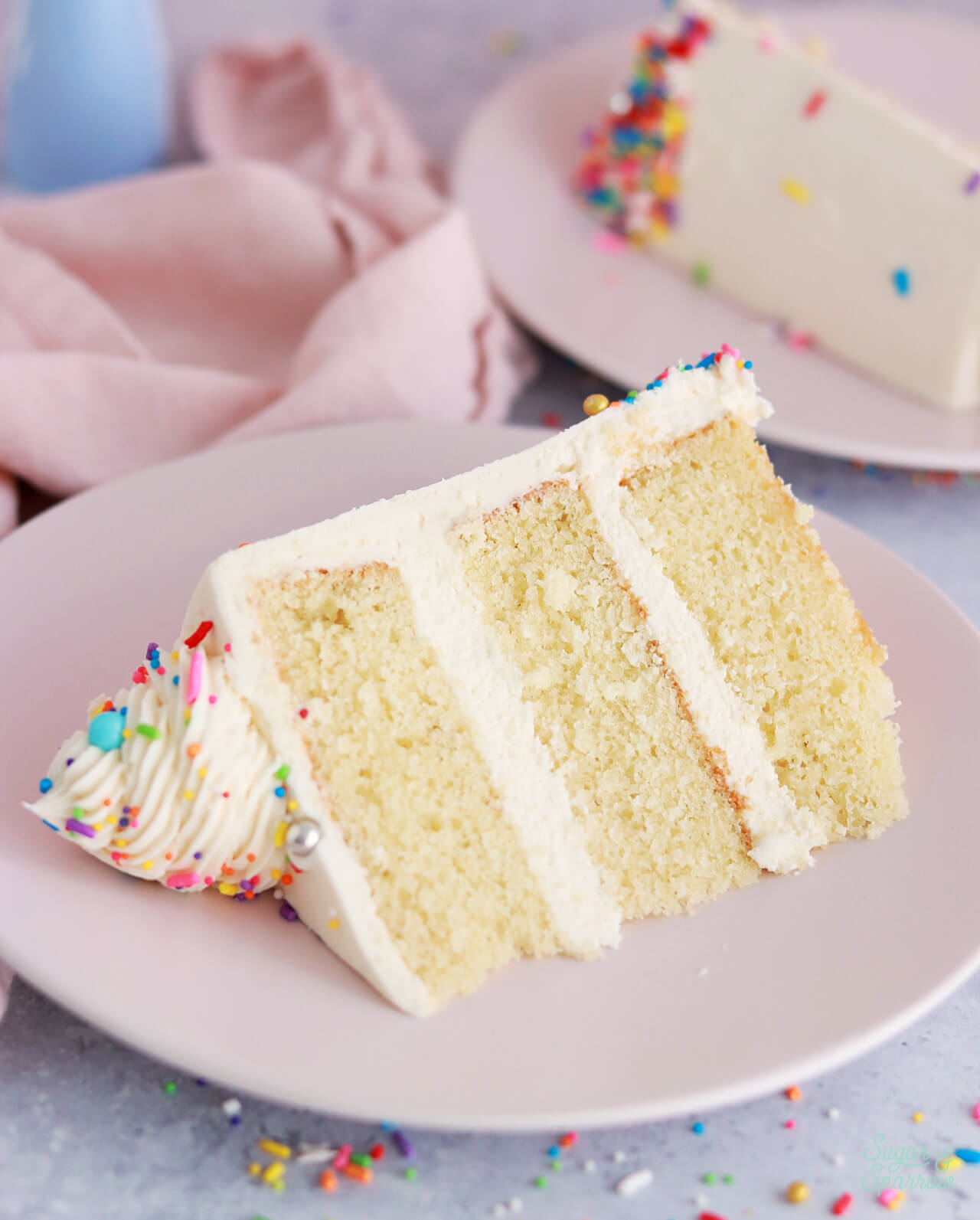
One reader, Haley, says: “1000% this is the best vanilla cake recipe I have ever made. I quite literally NEVER leave reviews on things that I try, but there is no way that I could go without telling you how DELICIOUS this cake is.” ★★★★★
From-Scratch Vanilla Cake that Rivals Box Mix
I have a little confession to make: when I first started making cakes, my secret go-to for far too long was the box vanilla cake mix by Betty Crocker.
Phew. Now you know.
Since I became accustomed to the light and fluffy texture of said box mix, every time I tried to make a vanilla cake from scratch, the result seemed off. Blame it on the lack of Propylene Glycol Mono (or the handful of other ingredients in box mixes that you’ve never heard of), but my from-scratch vanilla cakes always ended up too dense, tasted a little cornbread-ish, and just didn’t have that fluffy appeal. Finding a go-to vanilla cake recipe from scratch felt like a mountain I had to climb, but after (what felt like) five hundred tries and a whole lot of not giving up, I’ve found a recipe that is beyond my wildest cake dreams.
Perfect Vanilla Cake Ingredients & Substitutions
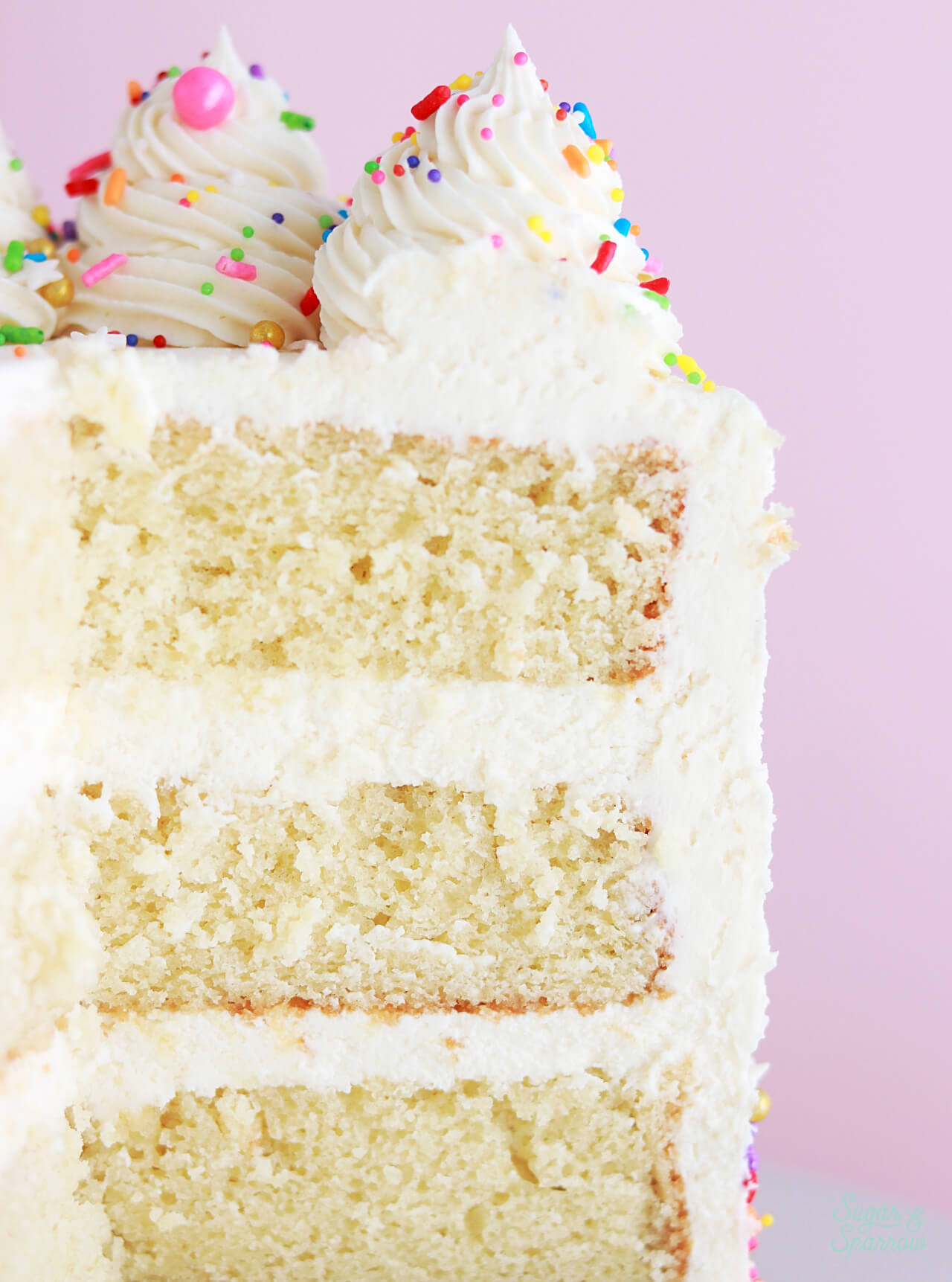
This vanilla cake is soft and moist, so easy to whip up, and tastes like a dream. There are some key ingredients that make it this way, and I’ve listed them below. I’ve also shared some substitutions that can be made just in case you’re in a pinch:
- Cake Flour. To achieve the super soft texture in this cake, I swear by cake flour. It produces a much fluffier cake than all-purpose (or plain) flour because of its lower protein content (the more protein in your flour the stiffer the dough and less ability to maintain moisture). You can find cake flour at most grocery stores, but if all you’ve got is all-purpose flour in your pantry, here are instructions for how to make your own cake flour. Keep in mind that if you do use the homemade version, the gram measurement will weigh more (325g instead of 290g) since all-purpose flour is heavier than cake flour.
- Baking Powder + Baking Soda. The leavening agents in this recipe. Using both makes it the perfect amount of fluffy.
- Unsalted Butter. The main fat in this recipe, which adds lots of moisture, great structure, and rich flavor. If you only have salted butter on hand, you can substitute that but be sure to omit the salt in the recipe if you do.
- Granulated Sugar. This not only sweetens the cake, it creates a tender crumb as well. You can substitute this with caster sugar if you wish and it will be even more soft.
- Whole Eggs + Egg Whites. I use two large eggs and two large egg whites in this recipe. The egg whites keep the cake lighter while adding the perfect amount of protein and binding power.
- Sour Cream. Sour cream adds the perfect amount of moisture to this cake. If you don’t have that locally you can substitute it for plain yogurt or Crème fraîche.
- Pure Vanilla Extract. I use an entire tablespoon of vanilla extract in this cake, which takes the flavor beyond! I recommend using a quality vanilla extract here (not imitation). You can substitute the extract for vanilla bean paste if you wish.
- Whole Milk. Since it has the highest fat percentage of any milk (aside from buttermilk), the whole milk creates a rich crumb while binding the ingredients together. You can technically substitute this for another kind of milk, but whole milk is going to yield the best results.
Vanilla Cake Baking Tips for Success
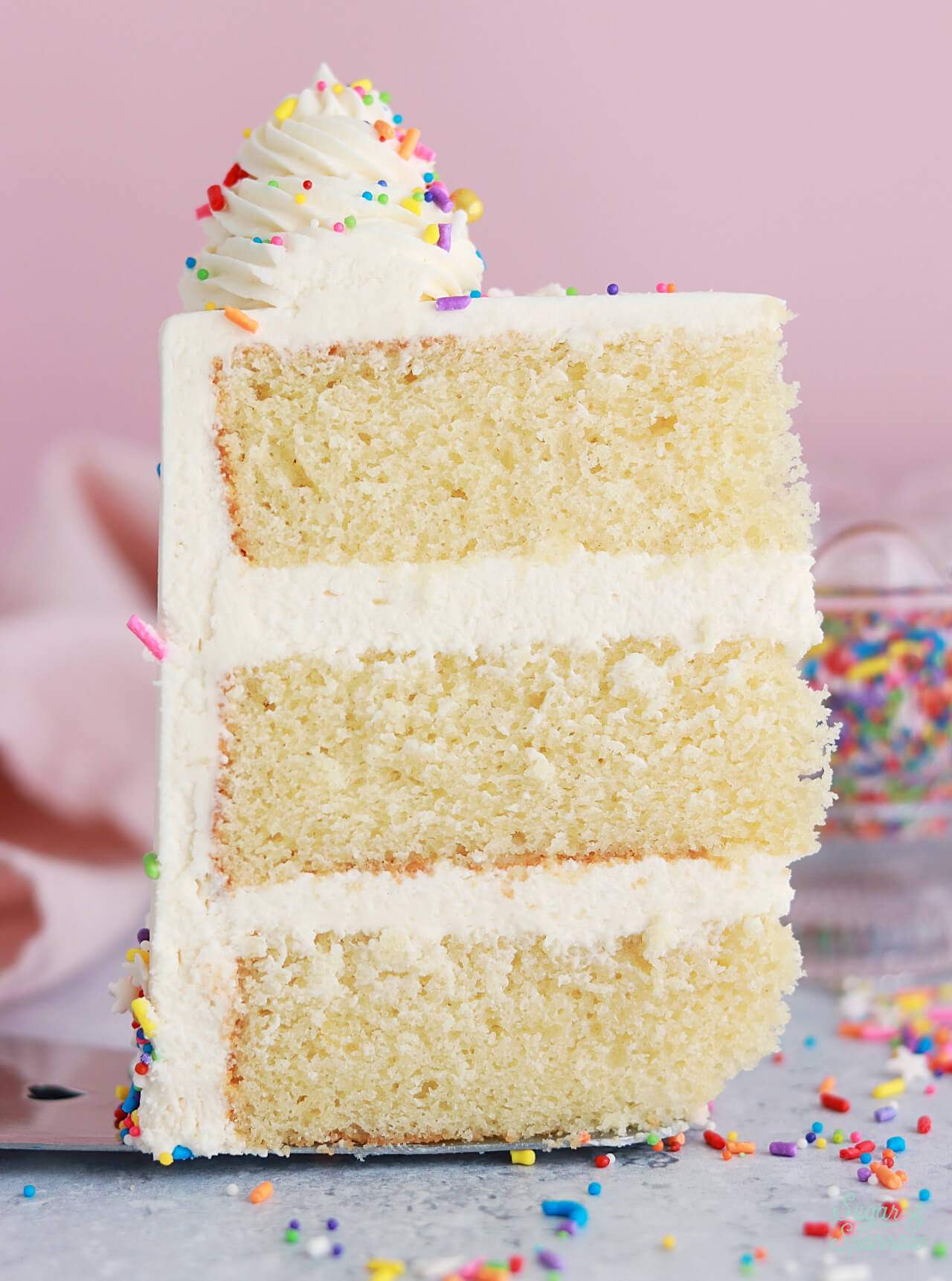
Even if you have all the right ingredients, it’s important to follow a few ground rules when it comes to baking this cake (or really any cake). Here are a few best practices that will really set you up for success:
- Start with room temperature ingredients. Cake baking is a science, and when ingredients like eggs, butter, and dairy are at room temperature, they form an emulsion which traps air in the batter. Once you place that batter in the oven, the trapped air expands and gives your cake a good rise and lovely, tender crumb. It’ll only happen when you use room temperature ingredients, so if you want your cake to live up to it’s true potential, don’t skip this step.
- Use fresh baking powder and baking soda. Each of these leavening agents are responsible for helping your cake to rise. Once their containers are open, they only have a six month shelf life! When they’re past their expiration date, the chemical reaction that causes your cake to rise won’t happen. If you want those cakes to rise beautifully, make sure your baking powder and baking soda are within that 6 month window.
- Use the paddle attachment on your stand mixer. Also known as the “flat beater” attachment, the paddle attachment helps incorporate just the right amount of air. Other attachments might add too much air to your cake batter, causing them to become over-mixed and potentially sink in the baking process. If you don’t have a stand mixer, an electric hand mixer works just fine.
- Be careful not to over or under mix. Under-mixing the batter will prevent important chemical reactions from happening in your cake batter, and over-mixing will lead to too much gluten development (aka a dense cake). In order to help you mix for the right amount of time, I’ve listed all of the mixing times in the recipe below. Follow those exactly for best results!
- Know your oven. I’ve written this recipe (and all of my recipes) for a conventional oven. If you have a convection or fan-assisted oven, you’ll want to reduce the baking temperature to 325ºF (163ºC) and check for doneness a few minutes earlier than specified.
Here’s a quick video to show you the process for making this vanilla cake:
If you love recipe videos like this one, be sure to check out my YouTube channel! I’ve got a growing collection of cake recipes, decorating tutorials, and Cake Basics over there. Hit the subscribe button on my page so you never miss a new video.
What Frosting to Pair with Vanilla Cake
This vanilla cake pairs well with so many buttercream flavors, but if you want to keep things on the vanilla spectrum, try pairing it with a double batch of my Vanilla Buttercream Recipe. It does not disappoint!
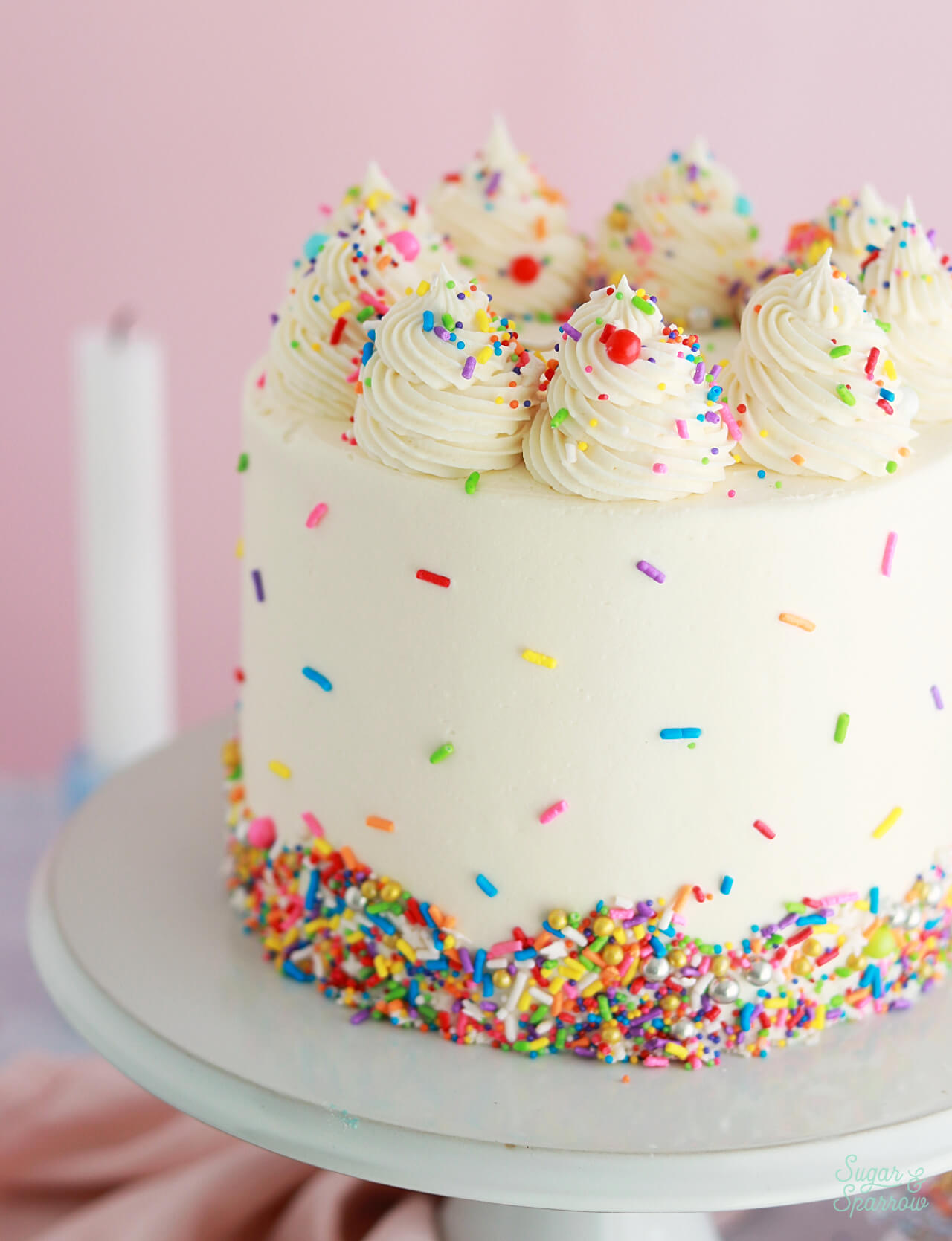
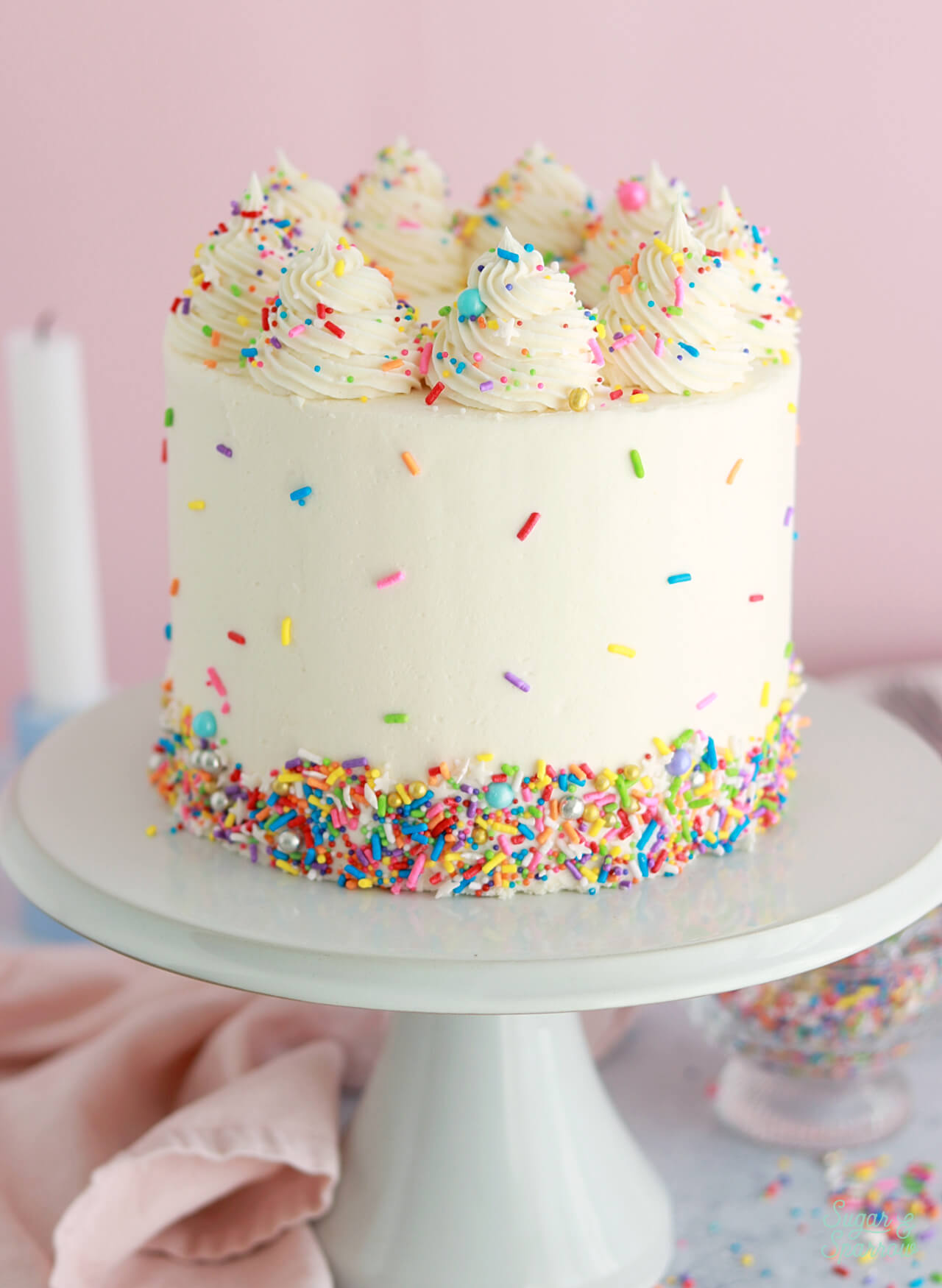
If you’d rather switch things up, a double batch of any of my frosting recipes will work great! I’ve got recipes for alternative cake fillings here as well.
Updates
In 2022: I slightly changed the measurements of these same ingredients to make this cake even more soft and light! The original recipe is in this youtube video if you’ve come to love that one.
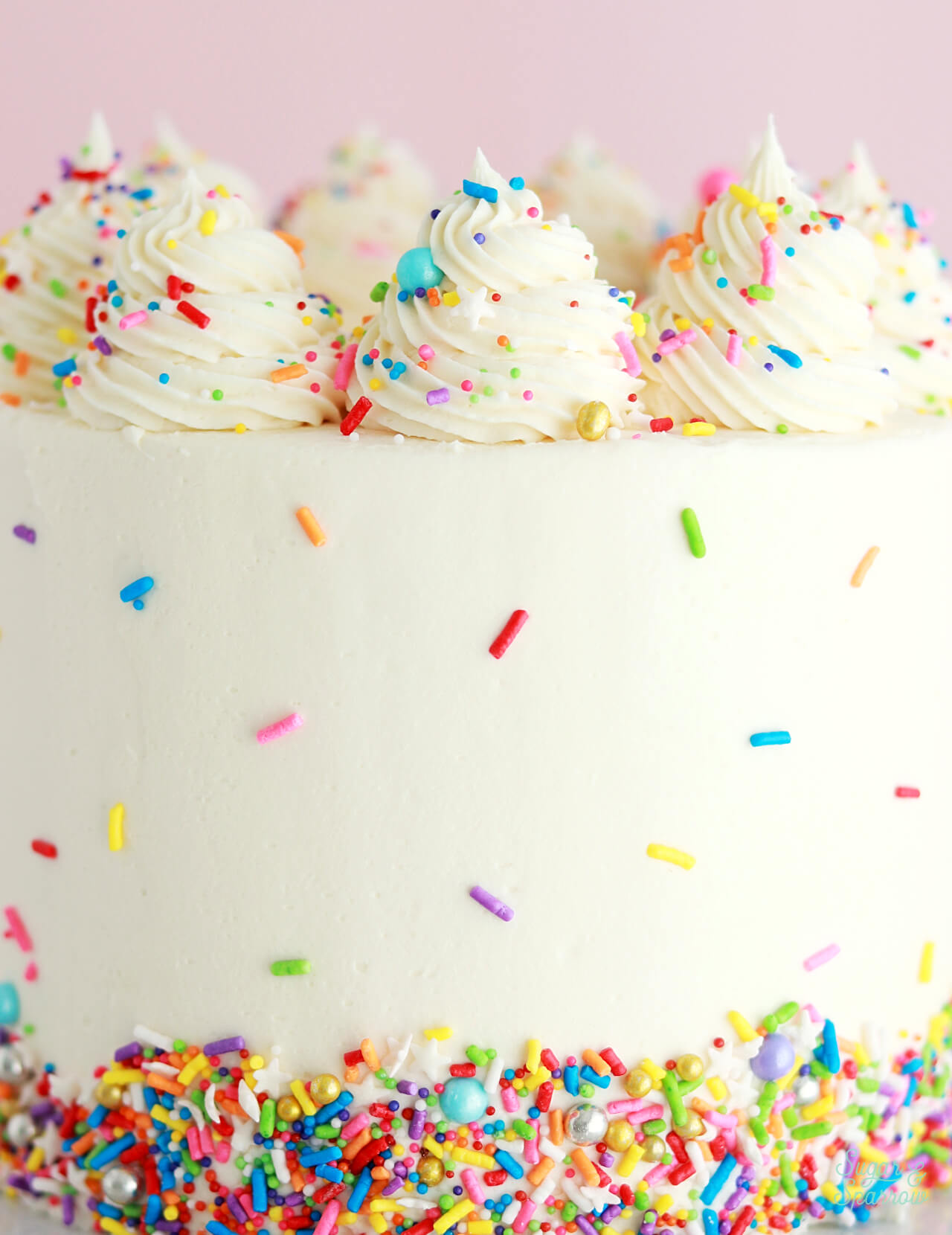
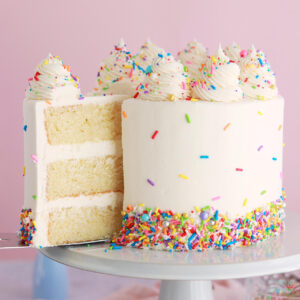
In 2025: I finally updated the photos to show more of the inside of the cake! The exterior decoration changed to reflect a simpler design as well. Basically a smooth buttercream finish, these pretty rainbow sprinkles, and swirls on top created with Wilton Tip 4B.
Perfect Vanilla Cake Recipe
Ingredients
Vanilla Cake
- 2 3/4 Cups (290g) sifted cake flour* DIY recipe in notes
- 2 tsp baking powder
- 1/2 tsp baking soda
- 1 tsp salt
- 3/4 Cup (170g) unsalted butter, room temperature
- 1 1/2 Cups (300g) granulated white sugar
- 2 large eggs + 2 egg whites, room temperature
- 1/2 cup (120g) sour cream, room temperature
- 1 Tbsp pure vanilla extract
- 1 Cup (240ml) whole milk, room temperature
Vanilla Frosting
- 2 batches vanilla buttercream
Instructions
- Preheat the oven to 350°F. Prepare three 6-inch cake pans or two 8-inch or 9-inch cake pans by spraying the sides with a cooking spray (Baker's Joy is my favorite) and fitting a parchment paper circle to the bottom of the pan.
- Sift the cake flour and then measure by spooning and leveling it in your measuring cup. Add the cake flour, baking powder, baking soda, and salt into a bowl and whisk to combine. Set aside.
- In the bowl of your stand mixer (a handheld mixer works fine too!), beat the butter on high for two minutes until it's light and creamy. Add in the sugar and continue to mix on medium-high for another two minutes. Turn the mixer to low and add the eggs and egg whites, one at a time, mixing until just combined and scraping down the bowl and paddle as needed. Add the vanilla and sour cream, turn the mixer to high, and beat for one full minute. It will look curdled at this point, but don’t worry – it will become smooth cake batter at the end.
- Add in the dry ingredients all at once and turn the mixer to low speed. Mix until just combined, then slowly pour in the milk. Continue to mix on low speed until just combined, about 30 seconds. Scrape down the sides and bottom of the bowl and give it a few stirs with a whisk to make sure there are no lumps. The batter will be slightly thick.
- Pour the batter evenly into the prepared cake pans and bake for 30-35 minutes. They're done when they spring back to the touch and a toothpick inserted into the middle comes out clean. Let the cakes cool in the pan for five minutes before turning them out onto a wire rack for an additional few hours of cooling. Make sure they're entirely room temperature before filling and frosting with a double batch of my vanilla buttercream (or any frosting!).

Hi Whitney! I was just reading your reply above and I am making sure. I always make cakes as you do: 3 6″ layers and I also love tall cakes. So, if I want to use buttermilk in this recipe, you say to omit the sour cream and use buttermilk in place of the whole milk. Just making sure. Also, to achieve 3 tall layers, I would make just a single recipe, not 1 1/2 recipes? Somewhere in this thread you also referenced your funfetti recipe; were you saying that this recipe and your funfetti are the same, just one has sprinkles and one doesn’t? Sorry for so many questions. Just looking for those 3 tall layers. Made your salted caramel buttercream today. Looking to make your vanilla cake soon and pair them. Hope all is well with you. 🙂
Hi Paula! To answer your questions: 1) yes, although I don’t recommend omitting the sour cream (because that’s the best way to make it extra moist), in a pinch you could omit the sour cream and sub buttermilk for the whole milk. It won’t be as moist as adding sour cream or even subbing that with full fat greek yogurt, but it’s the next best thing. 2) yes, to achieve three 6-inch layer that are roughly 2 inches tall, just keep this recipe as-is. If you look at the update disclaimer before the recipe, it explains that I changed the ingredient amounts to make just enough for three 6-inch layers or 2 9-inch layers. My funfetti recipe is the same, only with sprinkles added, and yields more batter (which is why the ingredient amounts are different).
So happy you love the salted buttercream recipe and can’t wait for you to pair it with this vanilla cake!
Thank you so much for your response. I guess my issue is that I seem to always have sour cream and buttermilk on hand, I just don’t have whole milk. I’d like to keep the sour cream but if I don’t have the whole milk, would you recommend keeping the sour cream and using 2%, which is what I always have? Thank you!!!
Yes, I would totally recommend keeping the sour cream and using 2% milk. That should be just fine!
You are so awesome in responding!!!! Thank you Whitney!!! <3
Hi
Can i substitute buttermilk for sourcream
Hi Aleena! A better substitute for the sour cream would be full fat greek yogurt, but if you want to use buttermilk in this recipe, you can omit the sour cream and use buttermilk in place of the whole milk.
Hi Whitney, I love your cakes and recipes and just made the vanilla cupcakes today. I love the recipe and was going to try the cakes next. Could I put vanilla bean into the recipe? Would it change how much extract I use? Thanks so much for being such an inspiration to a fairly new baker!
Hi Cheryl! Thanks for the kind words and I’m so happy you’ve been loving my vanilla cupcake recipe! Although I’ve never tried it before, you can use a vanilla bean instead of vanilla extract. From a quick Google search it looks like 1 vanilla bean is equal to 3 tsp of vanilla extract.
Would you use this Recipe for a wedding cake?
Hi Lynsey! I definitely would use (and have used) this recipe for a wedding cake 🙂
Hi Ayesha, that’s interesting that the cake tasted salty. I’ve never heard of that happening before. Did you by chance use salted butter instead of unsalted butter?
Hi Whitney,
I love this recipe! I make it all the time!! My question for you is that I noticed in the video the prepared round pans are placed on a baking sheet. Is that what do you suggest? I have not tried that yet.
Thanks,
Heather
Hi Heather! In the video I was just using the baking sheet to carry all three tins to the oven. I don’t bake the cakes on top of the baking sheet (sorry for the confusion!) so I just recommend placing the tins on the top rack in your oven. Sometimes I will place a baking sheet on the rack below to catch any overflow if I’m trying a new recipe and am unsure of how it will rise though!
Hi Whitney – I’ve made this cake twice now and everyone loves it. The only thing is that both times when adding the milk in the recipe the batter has curdled slightly. It doesn’t seem to have affected the taste but I was wondering if you have any idea why this happens?
Hi Elissa! Is the milk room temperature when you add it? If it’s even slightly colder than the rest of the ingredients, it will curdle the fat solids in the recipe. Ingredient temp and milk freshness are the only things I can think of that would curdle this recipe – it’s crucial that all dairy ingredients are room temp. I’m glad it’s been turning out well despite the curdling though!
Thanks for your reply Whitney. I did leave the milk out for an hour or so but perhaps it still was too cold (it’s Winter here).
I’m making the cake again for a birthday this weekend so will make sure I leave it out a little longer.
What can i do if I don’t have sour cream? It’s almost impossible to find it in my country
Hi Gianmarco! The purpose of the sour cream is to add extra moisture, and from my own experience the best substitutes for it are either 1) full-fat plain greek yogurt or 2) omit the sour cream and use buttermilk in place of the whole milk.
Hello!
I am a big fan of your beautiful creations! To start with, Shall I cut each ingredient to half so that I dont end up in eating a Big cake? I am the beginner inspired by ur work. What OTG or Oven mode you use to bake basic cake? Thanks in advance
Thanks so much, Benazir! If you want to make a small version of this cake, I would recommend my vanilla smash cake recipe (same recipe, just smaller portion): https://sugarandsparrow.com/smash-cake/
I use a conventional oven and bake all of my cakes at 350ºF (bake mode). Hope that helps!
This is going to be my cake for this birthday weekend! I only have light brown sugar on hand, would that work instead of white granulated sugar?
Hi Priya! I’ve never tried a cake recipe with all brown sugar before. I know that the added molasses will give the cake more of a caramel taste and add moisture, but I’m not sure how the texture of the crumb will be affected. Let me know if you try it and happy birthday weekend!
The cake looks so divine:) feel like trying the recipe. Can I know if I can substitute all purpose flour for cake flour?? Or does the recipe stick to cake flour only?? Request you to help me with that??
Thanks, Priyanka! Can’t wait for you to try it! Since the cake flour is what makes this recipe light and fluffy, my best recommendation is to make a homemade version of cake flour using all purpose flour (recipe here: https://sugarandsparrow.com/homemade-cake-flour-recipe/). If you don’t have corn starch handy, you can use straight all purpose flour but be sure to sift it a few times. It may end up being a little more dense than if you used cake flour but will be tasty nonetheless!
Thank you for replying and so promptly!
Going to give it a try tomorrow, so I’ll let you know how it goes. x
Hi
I want to give this a try for my twin nieces birthday – specifically your fault line cake! Have just bought two 6″ deep tins. Would the original quantity work? if I left it for around 45 mins and should I keep the oven temp the same?
Thank you
Hi Lindsey! I’ve never baked this cake recipe (or any cake recipe!) in a pan deeper than 2 inches, so I’m no expert on deep dish cakes or how to alter this recipe to work for a deeper pan. From what I’ve researched about deep dish pans, it sounds like it’s not a good idea unless you’re baking a cake with a dense crumb (like a fruit cake). Since this recipe is meant to be light and fluffy, it may not end up that way if baked in a deep pan. If you want to give it a go though, all the Googling I’ve done says to lower the oven temp and bake for longer, so maybe try 300 degrees for an hour or more. Let me know if you end up trying it, I’m curious as to how it will turn out!
I’m planning on making this cake for a friend this Valentines Day! Do you have a tutorial on how to decorate the cake like yours? I’m going to use your vanilla cake and buttercream recipe and I would love to decorate how you did as well!
Thank you!
Hi Evette! I don’t have a tutorial on this particular cake design, but it’s basically just an ombre finish with swirls on top piped with Wilton Tip 4B, then sprinkled with the Sprinkle Pop “Hey Sugar” sprinkle mix. I used Americolor Fuschia for the pink color. Here’s a blog post that shows how to create an ombre buttercream finish, only use a color palette of Fuschia, White, and those two colors mixed together for the middle tone: https://sugarandsparrow.com/under-the-sea-cake-tutorial/
Hello! I would love to make this as a peanut butter flavored cake, any ideas on how to incorporate the peanut butter? Thank you! Making the vanilla as well for top tier.
Hi Jennifer! You’re in luck. I have a great peanut butter cake recipe here (basically this vanilla cake recipe with peanut butter added): https://sugarandsparrow.com/chocolate-peanut-butter-cake-recipe/